

Khammam Buero,
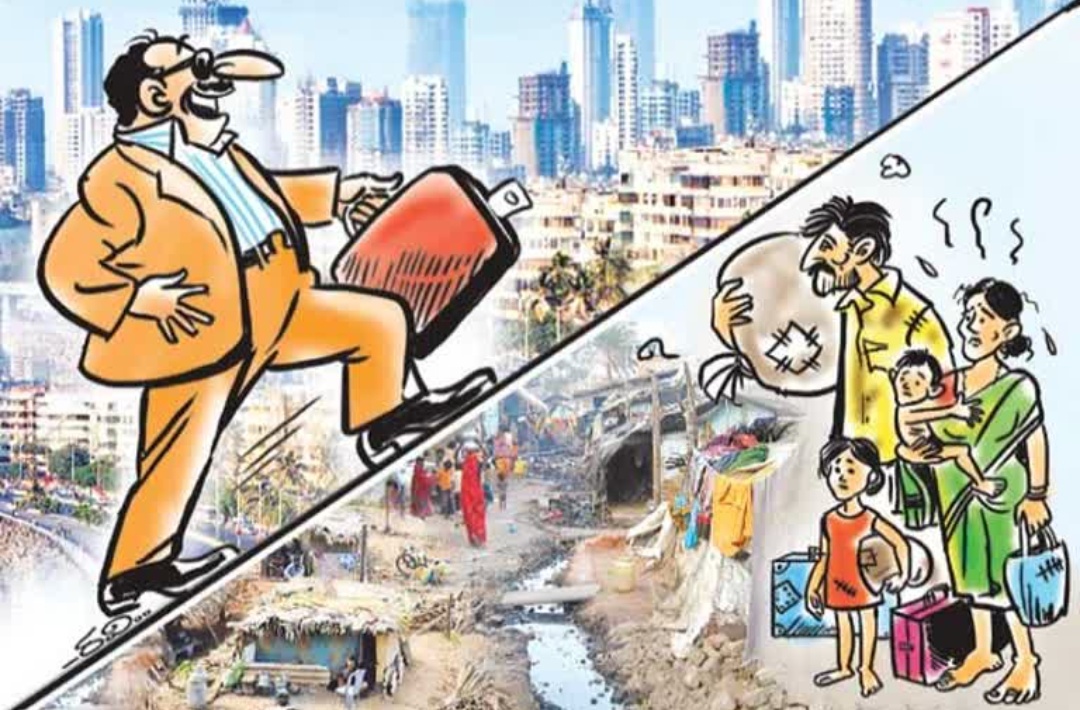
The organization Oxfam, which works under the banner ‘Movement to End Inequalities’, recently released a report. This 37 page document once again revealed how, beneath the slogans of development and patriotism, vast piles of wealth are accumulating in the hands of a few while unbearable burdens are falling on the poor. In short, it ripped open the belly of the investment system and exposed the worms inside.
On one side, rulers and their cheerleaders boast that India is racing to the top of the world, that the time has come for the nation to become a global teacher. Yet, at the same time, various international reports lay bare the harsh realities of ordinary Indians lives. Hunger, human freedom, health and livelihood, human development, press freedom, pensions on every such global index, India has fallen far behind in 2022 compared to 2014. Meanwhile, the number of billionaires is rising dramatically every year. Excluding the unlisted ‘Shadow billionaires’, even official figures show that the number of billionaires in India increased from 102 in 2020 to 166 in 2022. This is no miracle, no magic it is the direct result of investment driven governance and government policies tailored for the super rich.
● What did the Oxfam report say?
According to the report, The richest 30% of Indians hold 90% of the country’s wealth. The top 10% alone control 80%, The top 5% control 62%, And the top 1% command a staggering 40.6% of the nation’s wealth.
In contrast, the bottom 50% of the population holds only 3%. Between 2012–2021, 40% of newly created wealth went to these billionaires. Even during the pandemic, while the world was reeling, their profits soared by 121%. That’s the equivalent of ₹2.5 crore every minute, ₹3,068 crore every day.
At the same time, India has the largest number of poor people in the world 228.9 million. In just four years, the number of poor in India rose from 190 million to 350 million. Due to tax exemptions in 2020–21, corporate companies collectively benefited by ₹1,03,285.44 crore. The 100 richest Indians together hold ₹54.12 lakh crore, of which the top 10 billionaires alone control ₹27.52 lakh crore. Gautam Adani’s wealth alone rose eightfold during the pandemic, reaching ₹10.96 lakh crore, making him India’s richest man. Others like Cyrus Poonawalla, Shiv Nadar, Radhakishan Damani, and Kumar Birla also increased their wealth by 20% in 2022 compared to the previous year. The Ambanis, of course, remain on par.
What’s striking is that these new billionaires are not primarily profiting by setting up industries, producing goods, and selling them. Instead, many are exploiting essential services. For instance, 32 billionaires are in the healthcare sector, controlling hospitals and pharmaceutical industries—reaping massive profits. Cyrus Poonawalla, Dilip Shanghvi, and Murali Divi lead this list. Government healthcare was deliberately weakened under the guise of “liberalization,” while corporate healthcare was strengthened immensely.
Similarly, education has become another major business sector. In construction and services, billionaires exploit both laborers sweat and citizens pockets. Decades old public sector enterprises built with workers physical and mental labor are being sold off cheaply for corporate profit. The cooperative system has been dismantled, replaced by an all encompassing privatization drive.
◆ This is a Corporate Government.
Years ago, renowned journalist P Sainath wrote a book Everybody Loves a Good Drought, showing how politicians and officials exploited even droughts to loot public money while the poor starved. In the same way, during the pandemic, the central government ensured corporations made windfall profits. In 2020–21, corporate companies earned 70% more profits, while the incomes of 84% of India’s people fell drastically. Gautam Adani alone profited by ₹1,612 crore per day. Even before COVID, in 2019, the government had slashed the corporate tax slab from 30% to 22% and for new companies, to just 15%. As a result, corporate tax collections fell by 16%, costing the nation ₹1.84 lakh crore.
Adding to this, corporate loans from banks were waived en masse 2017–18 ₹1,61,328 crore, 2018–19 ₹2,36,265 crore, 2019–20 ₹2,34,170 crore, 2020–21 ₹2,02,781 crore, 2021–22 ₹1,57,096 crore, That’s a total of ₹9,91,640 crore in just five years public wealth handed to corporates by a ‘patriotic’ government.
◆ Even a Small Tax on the Rich Could Help.
Oxfam argues that even a modest tax on billionaires could significantly reduce poverty. For example A 3% one time tax on billionaires could fund India’s health mission for five years. A 2% tax could ensure nutritional support for three years. A 20% tax on the extraordinary profits companies made between 2017–2021 would yield ₹1.79 lakh crore, enough to pay salaries for 50 lakh primary school teachers for one year.
In short, even within the capitalist system, immediate remedies exist. The report urges that these solutions be spread widely among the people and demands that at least such measures be implemented. That, it concludes, is the duty of patriots and lovers of the people.