

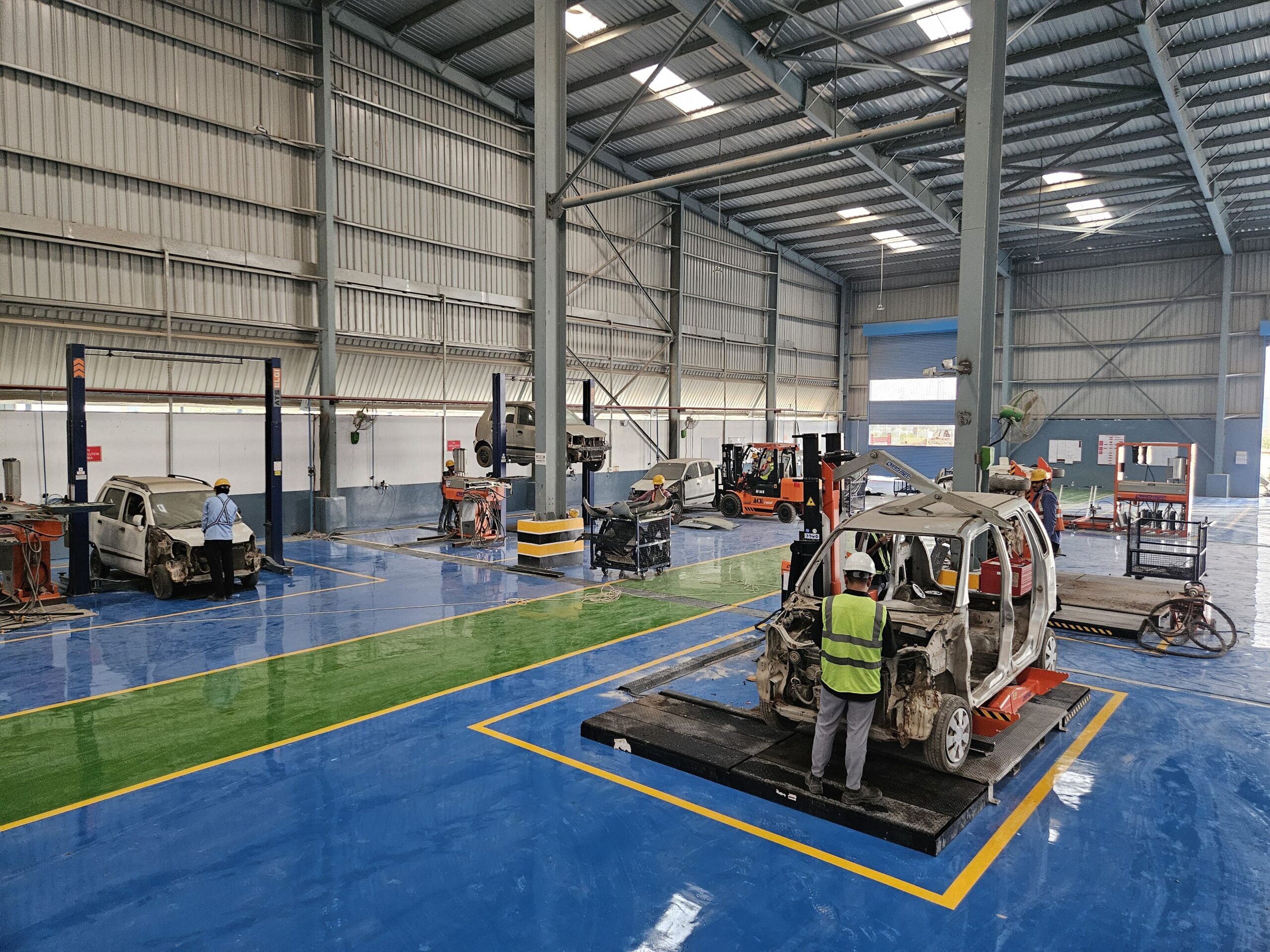
Re Sustainability Limited (ReSL), one of Asia’s leading circular economy and sustainability solutions providers, has established Re Carma as India’s largest End-of-Life Vehicle (ELV) recycling ecosystem. Anchored at the Reliance Model Economic Township in Jhajjar, Delhi NCR, Re Carma’s flagship state-of-the-art facility has an installed capacity to dismantle over 30,000 vehicles annually, including passenger cars, commercial vehicles, and earthmoving equipment. Beyond this hub, Re Carma already operates through a pan-India franchisee and partner network, creating the largest organized ELV recycling footprint in the country, with a cumulative national capacity exceeding 200,000 MT per annum.
The Re Carma network has been built with differentiated technology and infrastructure designed to maximize material recovery and sustainability performance. It integrates automated dismantling and advanced recycling processes across plastics, ferrous and non-ferrous metals, critical minerals, and precious metals, while meeting stringent national and international standards. This makes Re Carma not just India’s largest ELV facility but also the country’s most advanced ELV recycling network, trusted as the exclusive pan-India recycling partner for some of the world’s largest global auto OEMs. Along with other in-house facilities and technologies that Re Sustainability has developed across different feedstock categories and regulated wastes, this completes Re Sustainability’s vision of being the leading global provider of integrated 360° circularity solutions across industries.
ELV facilities: The need of the hour in India
Data from the Ministry of Road Transport and Highways (MoRTH) shows that India has 5.1 million light motor vehicles older than 20 years, and another 3.4 million over 15 years old. The Central Pollution Control Board (CPCB) estimates that by 2025, more than 20 million vehicles nationwide will reach end-of-life. Left unrecycled, these obsolete vehicles can pose serious threats to human health, air quality, soil, and water resources. The Re Carma network provides a structured, formal, and environmentally sound solution to this challenge by delivering internationally benchmarked recycling services at scale.
Adhering to international standards and the vehicle scrappage policy
Re Carma is fully compliant with India’s voluntary vehicle scrappage policy. It plays a crucial role by issuing government-recognized Certificates of Vehicle Scrapping (Form-4), ensuring transparency through integration with the VAHAN national database. Each certificate is supported by digital records, including a chassis cut-out photograph, to update and validate the official register. The network operates in compliance with ISO 9001 for Quality Management, ISO 14001 for Environmental Management, and ISO 45001 for Occupational Health & Safety. By adhering to these benchmarks, Re Carma ensures safe dismantling, high recovery rates, and minimal environmental impact while formalizing a sector that has largely been informal.
