
KLEF Deemed to be University Achieves Landmark in Student Space Research with Triple Satellite Success

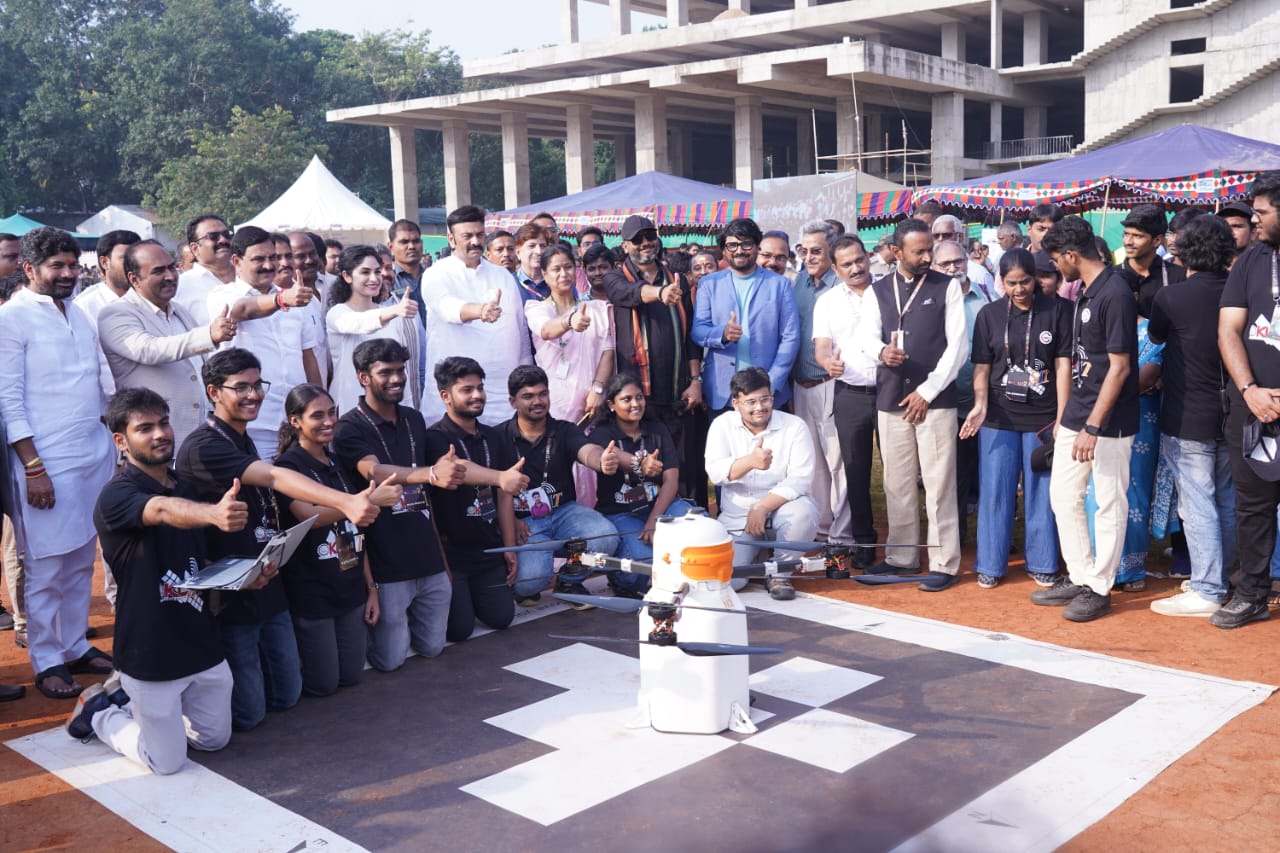
In a historic stride for student-led space innovation and technology demonstration, KL Deemed to be University (KLEF) successfully launched its three student-built satellites — KLSAT-2 (2U CubeSat), KLJAC (Lightweight Pico Balloon Satellite), and CanSat (4U Module) — from its Vaddeswaram Campus, marking a defining moment in the institution’s pursuit of indigenous space technology and research excellence.
Designed under the student satellite project, the initiative was led by the KLSAT Team from the RF & Microwave Centre of Excellence, in collaboration with Andhra Pradesh State Council of Science & Technology (APCOST) and REDWING.
The event was graced by Shri Kanumuru Raghu Rama Krishna Raju Garu, Deputy Speaker, Andhra Pradesh Legislative Assembly; Shri Bhupathi Raju Srinivasa Varma Garu, Union Minister of State for Heavy Industries & Steel; and Shri Koneru Satyanarayana Garu, President and Chancellor, KLEF. Distinguished dignitaries from industry, ASI, and academia, along with researchers, experts, faculty members, and students, also witnessed the event.
Shri Kanumuru Raghu Rama Krishna Raju Garu praised the students’ dedication and creativity, while Shri Bhupathi Raju Srinivasa Varma Garu lauded the university’s initiatives in advancing indigenous technology and nurturing future-ready talent.
Each of the three missions carried distinct objectives and outcomes. KLSAT-2 (2U CubeSat) with Hybrid Aeroswift VTOL Flight-Cum-Flight Module, an upgraded version of the earlier KLSAT-1 (launched in 2023), evolved from a 1U to a 2U CubeSat, enhancing its capability for scientific research, environmental monitoring, spectrometer-based data collection of 18 wavelengths and real-time communication under near-space conditions. The mission, lasting 60 to 90 minutes, focused on environmental data collection and drone-assisted CubeSat deployment — marking a first-of-its-kind experiment by students.
The CanSat module, equipped with a Hybrid Coaxial Tricopter, was the only student satellite from Andhra Pradesh shortlisted for the National-Level CanSat Competition conducted by IN-SPACe, ISRO, and the Astronautical Society of India (ASI). It operated for about 15–20 minutes, demonstrating innovation in CAN satellite design with Atmospheric sensors and a parachute-based recovery system with innovative deployable payload, and is now being adapted for orbital launch in 2026.
