

‘They fired a gun, and with that bullet the judicial system is now bleeding’, remarked the Chief Justice of India (CJI), Justice Suryakant, sparking intense controversy. He expressed strong displeasure over the National Council of Educational Research and Training (NCERT) printing a chapter titled ‘Corruption in the Judiciary’ in the Class VIII Social Science textbook for students. Taking suo motu cognizance of the issue, the Supreme Court began hearing the matter. The CJI’s sharp reaction and remarks during the proceedings became a major topic of discussion. In response, the Central Government offered an unconditional apology to the apex court.
During the hearing, the CJI observed, ‘With the bullet they fired, the judiciary is bleeding. It appears to be a deliberate conspiracy to undermine the authority of the judiciary and tarnish its dignity. If we ignore this, the sanctity of the judiciary may be damaged in the minds of the public and the youth’. He further stated, ‘A full chapter has been allocated to explain corruption in the judiciary, but the distinguished history of the courts has been omitted. We will not let this matter rest until accountability is fixed. We want to know who is behind this’.
On behalf of the Central Government, Solicitor General Tushar Mehta tendered an unconditional apology and clarified that the controversial chapters were prepared by two individuals who were not working in coordination with the UGC or any ministry. Responding to this, the CJI remarked, ‘It is very easy to say so; in that case, they can escape very easily’.
The Supreme Court ordered a complete ban on the Class VIII Social Science textbook in question and directed that all copies already published be withdrawn. The apex court issued five types of directions, ranging from imposing an immediate ban on the book to seizing all copies. It also directed that digital versions of the book be removed.
The bench comprising Chief Justice Suryakant, Justice Jomalia Bagchi, and Justice Vipul Pancholi directed that the names of the authors who wrote the controversial chapter, as well as the original minutes of the meeting in which it was discussed and finalized, be submitted at the next hearing. Show-cause notices were issued to the NCERT Director and the Secretary of the School Education Department. The court also asked why criminal contempt proceedings should not be initiated against those responsible for the objectionable chapter.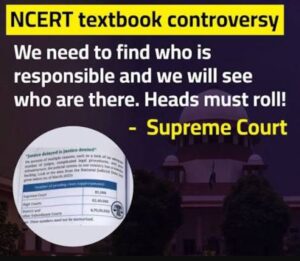
● Withdraw Every Copy.
The Supreme Court directed that every copy of the Class VIII Social Science textbook whether in hard copy or digital form be immediately withdrawn. It instructed NCERT to coordinate with both the Central and State Governments for this purpose. The court ordered that copies be removed from bookshops, schools, and online platforms without delay. The responsibility of retrieving books already distributed to schools was entrusted to NCERT Director Dinesh Prasad Saklani. Along with him, the Principal Secretaries of the Education Departments in the states were also directed to implement the orders and submit compliance reports to the court.
The court further instructed that teachers must not use the textbook in classrooms under any circumstances and that the content should not circulate indirectly. A ban was imposed on the printing and supply of the textbook. Any attempt to distribute the book in physical or digital form would be treated as a deliberate violation of the court’s orders. The court also directed the NCERT Director to submit the names and identification details of the members of the National Syllabus Board who were involved in preparing the chapter. Referring to an earlier statement issued by NCERT during the hearing, the bench observed ‘We have seen the NCERT notice. The word ‘apology’ does not appear anywhere in it. This is how the Director has responded. There appears to be no remorse only justification’.
● Not an Attempt to Suppress Constructive Criticism.
The Supreme Court clarified that it does not intend to suppress constructive criticism of the judiciary. ‘We do not wish to curb the right to critically examine the judicial system or to make lawful criticism in these suo motu proceedings’, the bench stated. It emphasized that its intervention was not aimed at silencing criticism, but at safeguarding academic integrity. The court opined that it is inappropriate to provide students with biased information.