

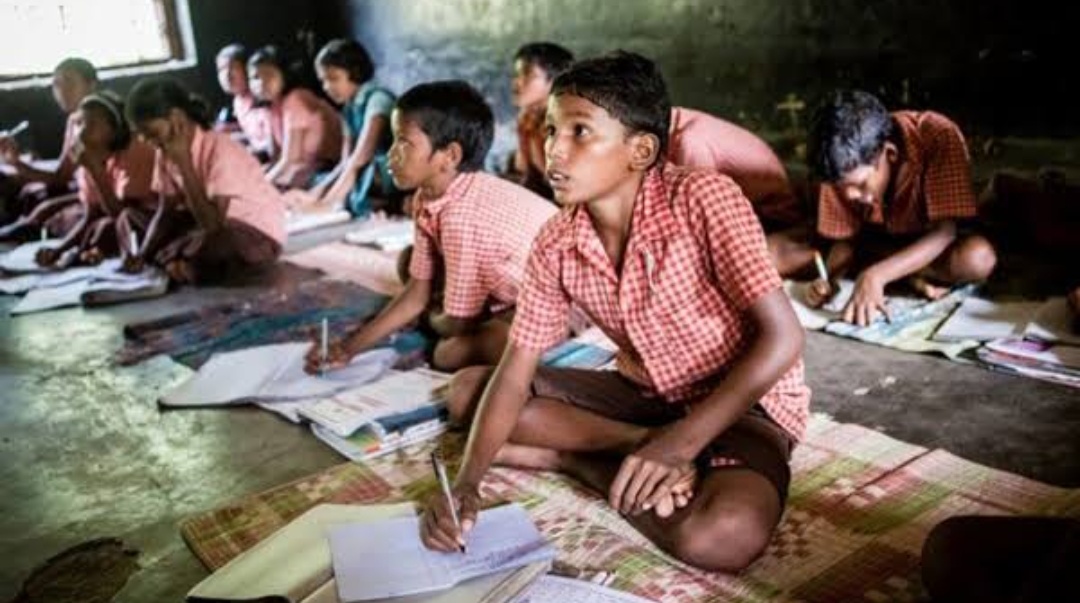
A recent national survey conducted by the Indian Ministry of Education reveals an alarming decline in school education standards across the country. The survey, carried out through the ‘PARAKH’ (Performance Assessment Review and Analysis of Knowledge for Holistic Development) initiative, assessed over 2.1 million students from Classes 3, 6 and 9 in 74,229 government and private schools across 781 districts in 36 states and union territories. Launched on December 4, 2023 and published in July 2025, the findings underscore a pressing need for immediate intervention by both central and state governments. Not only do the results point to declining academic performance, but they also raise serious questions about current educational policies and priorities. According to the report, 71% of sixth-grade and 69% of ninth-grade students struggle with basic arithmetic like addition and division. This contradicts the narrative of India’s rise as a global economic powerhouse. The findings highlight the consequences of education being commercialized, pushing millions of families into debt while catering only to a privileged few, leaving the majority behind. PARAKH, established in 2023 under the National Education Policy (NEP) 2020, aims to elevate education quality, reduce disparities and develop 21st century skills. When compared with the 2021 National Achievement Survey, the new data shows a sharp decline in student performance as they progress to higher grades. It found that while third-grade students demonstrate encouraging language and numerical abilities 67% use new words confidently and 99% can sequence numbers ninth-grade students lag significantly, especially in language skills. The report identifies early education in the mother tongue as a critical factor for success, asserting that children express themselves more naturally in their native language. It indirectly criticizes the push for English medium and even Hindi medium instruction at the cost of regional languages. Subjects like history and social sciences, essential for civic understanding, have been deliberately weakened over the past three decades. The report raises concerns that only 45% of ninth-grade students understand fundamental constitutional principles and just 34% can differentiate between living and non-living things. It also suggests that pseudoscience and superstition, including astrology and folk medicine, promoted by school curricula and media, are harming children’s scientific temper.
Despite the national obsession with engineering and technical education fuelled by IT sector growth only 54% of sixth-graders understand place value and just 29% can perform basic division. Among ninth-graders, only 31% grasp concepts like integers and fractions. The government’s aggressive focus on mathematics and engineering has not translated into better outcomes, revealing a serious flaw in approach. Kerala tops the list in all three grades surveyed, showcasing the success of its long-standing investment in public education and innovative practices from promoting awareness about food and labor to using robots in classrooms. Other top-performing states include Punjab and Himachal Pradesh. On the other hand, tribal and minority-dominated regions like Jharkhand, Jammu & Kashmir, and Meghalaya fared the worst. The findings underscore that education reform cannot be one-size-fits-all. They call for identifying students individual interests and offering personalized learning paths starting from primary education. With China commanding 25% of global patents through robust research and development while India lags below 1%, the failure to align education with student potential and national goals is evident. In conclusion, the survey is a wake-up call demanding a rethink of policies that reduce education to a commercial enterprise or a tool of cultural homogenization. Policymakers must regulate exploitative educational institutions, reinvest in public education and nurture children’s diverse talents to secure India’s future.