

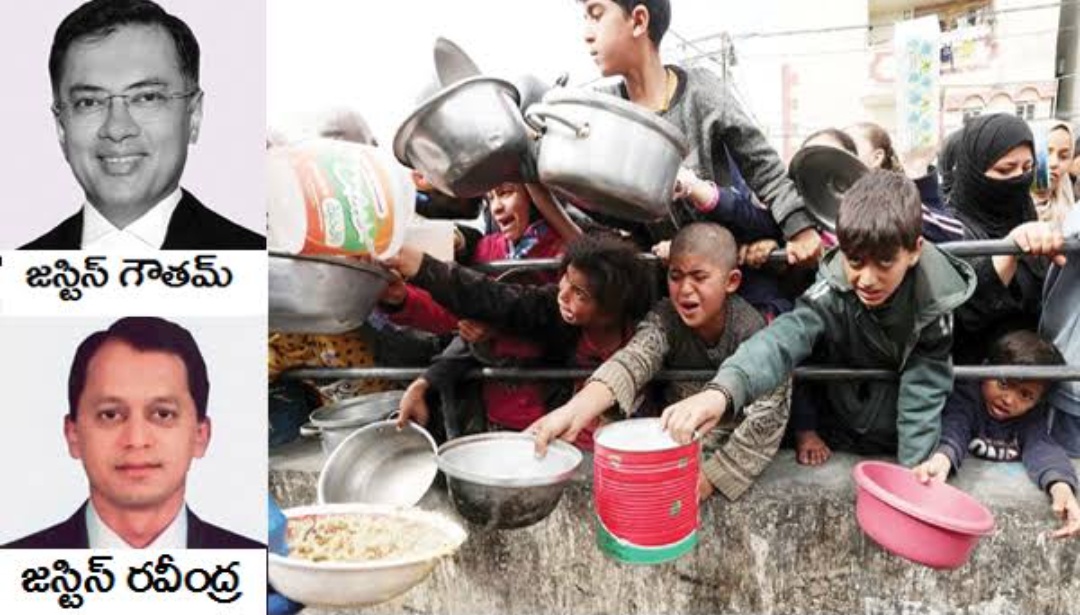
The remarks made by two Bombay High Court judges Justice Ravindra Ghuge and Justice Gautam Acharya have stunned the nation. While dismissing a petition filed by the Communist Party of India (Marxist) seeking permission to protest against the ongoing genocide in Gaza by Israel, their comments, delivered with an air of righteousness, were astonishingly scathing. From the bench, they admonished the petitioner to ‘first demonstrate patriotism for your own country’. In a patronizing tone, they went further ‘Our nation already has more than enough issues to deal with. We don’t see any necessity for this (protest). I regret to say you’re acting with a narrow perspective. You’re turning your back on what’s happening in your own country while looking toward Gaza and Palestine. Why don’t you do something for your own nation? Focus on your country’. They didn’t stop there, ‘Be patriotic. This is not patriotism’, they declared. Believing they were speaking as the moral voice of the judiciary, they warned, ‘You have no idea how much controversy this could stir. Why do you want to side with Palestine or Israel? Looking at the party you’re representing, do you even understand the impact this could have on our foreign policy?’. They added ‘You’re a registered organization in India. You could protest against garbage accumulation, pollution, dirty water, floods. We’re only giving a few examples. But you’re not protesting any of those. You’re protesting something happening thousands of miles away’.
● Do They Even Know the History of Solidarity?
It’s unfortunate that these judges seem unaware of India’s own freedom struggle and the consistent solidarity shown by successive Indian governments toward the Palestinian cause. India has continually supported Palestine’s right to self determination and sovereignty. For decades, Israel has denied Palestinians access to their own land. The judges appear grossly uninformed not just about the historical context, but also the rising global condemnation of the genocide in Gaza. Numerous international bodies including the International Court of Justice and various UN institutions have voiced clear criticism of Israel’s actions. Even Western governments like France have had to face internal dissent for not opposing Israel’s starvation tactics in Gaza, which violate the UN Declaration of Human Rights.
● Even the Indian Government Has Not Remained Silent.
Even the Indian government has had to tacitly acknowledge the severity of Israel’s actions. India’s Permanent Representative to the United Nations in New York admitted that Gaza’s healthcare and education systems are in dire condition. According to the UN Human Rights Office, over 650,000 children have been without school for 20 months. So this is not just a protest meant to stir foreign policy debates, as the judges claimed it’s a response to a grave humanitarian crisis that even governments can no longer ignore.
● An Anti-Communist Bias?
The judges reaction seems to stem not just from concerns about foreign policy, but from a deeper anti-communist sentiment. The very issues they grudgingly acknowledged garbage, pollution, floods are precisely the local issues that CPI(M) activists work on every day. Just because a party engages with local problems doesn’t mean it forfeits the right to take a stand on international humanitarian issues. That right is enshrined in the Indian Constitution.
● Ambedkar’s Clarification.
The Indian Constitution is unambiguous on the independence of the judiciary from the executive. On December 10, 1948, during debates over Article 50 concerning the autonomy of the judiciary, Dr B R Ambedkar stated clearly that there were no differences among the drafters about maintaining judicial independence. Again, on May 14, 1949 he reiterated that the judiciary should not only be independent but also effective. But in today’s dark times, the concept of ‘judicial autonomy and competence’ is under severe threat. Signs of this judicial disorder are now visible not only in the Bombay High Court but also in some Supreme Court rulings such as the Ayodhya verdict, the abrogation of Article 370 in Jammu and Kashmir and the approval of amendments to the Prevention of Money Laundering Act that empower the ED disproportionately. Across all court levels, we see a dangerous trend of aligning with the executive rather than acting as an impartial pillar of democracy.
● Lessons from Nazi Germany.
Those who forget history are doomed to repeat it. The Nuremberg Laws in Nazi Germany serve as grim warnings. These laws didn’t just strip Jews of their rights they also perverted the judicial process itself. Except for a few courageous exceptions, most judges and prosecutors became enforcers of Nazi ideology, sidelining legal principles for political motives. Today, with Hindutva ideology spreading venomously across India, our secular, democratic republic faces a similar peril. There’s a concerted effort to reshape all institutions including the judiciary into instruments of majoritarian authoritarianism. Ignoring this danger invites collapse.
As one commentator chillingly put it, ‘When courts begin echoing Hindutva rhetoric, it’s time to worry. The water has already reached our heads’. Unless we resist this dangerous trend and push back, we risk being dragged into its abyss.