

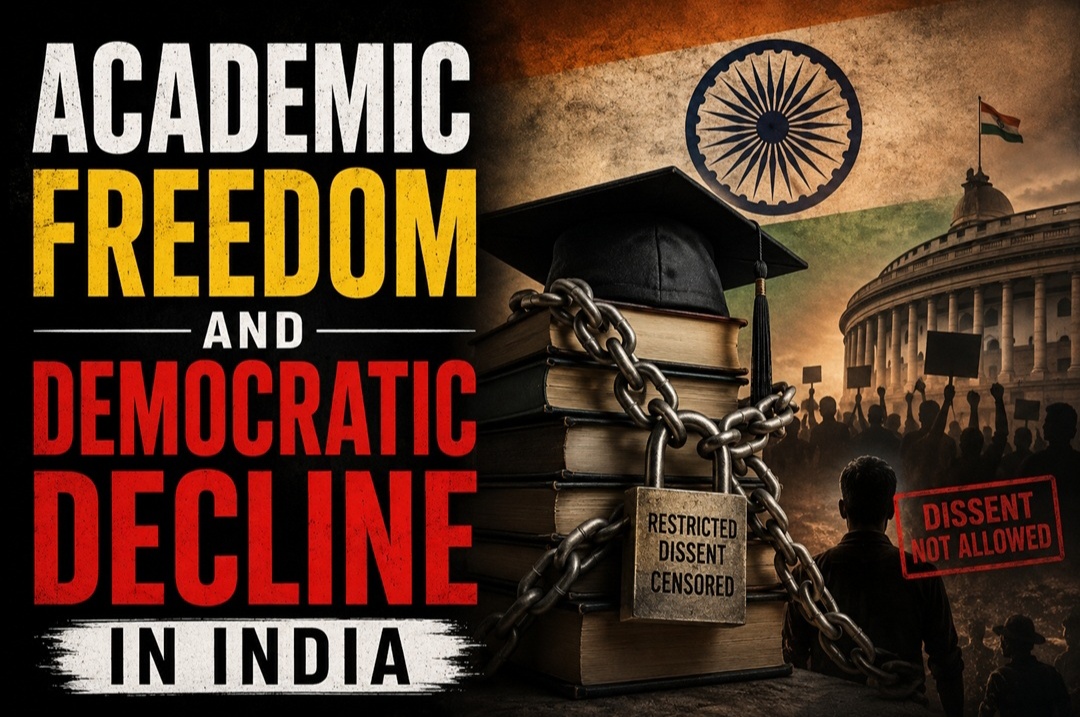
According to the Varieties of Democracy (V-Dem) Report 2026, although elections are being conducted in India, the country continues to be categorized as an electoral autocracy. India has been placed in the lower ranks among nations worldwide in this regard. The report particularly states that freedom of expression, media independence, civil society freedom and democratic rights are steadily declining in India. It also notes that institutions supporting accountable governance, pluralism and democratic norms are gradually becoming ineffective, placing India among the countries ‘rapidly moving toward authoritarianism’.The report further points out that these developments are raising concern at the international level. Another report, Schools at Risk: Free to Think 2024, noted that academic freedom in India is ‘highly restricted’. It stated that increasing political interference and pressure on educational institutions are weakening university autonomy. The report specifically highlighted the institutionalization of a Hindutva nationalist agenda within higher education. Changes in curricula, restrictions on research freedom, and shrinking space for intellectual debate were identified as troubling developments. This is not an isolated observation. It aligns with a broader pattern reflected in global reports by institutions ranging from V-Dem to Freedom House, all indicating a decline in democracy in India. Universities in India, once known as spaces for critical thinking and diverse discussions, are increasingly losing guarantees for the freedom to teach, learn and question.
However, there has been relatively little discussion about how the decline of academic freedom weakens democracy. Healthy democracy requires not only elections, voting rights and laws, but also a strong civil society, access to evidence-based information, and space for genuine public debate. Today, these spheres – particularly higher education – are increasingly under pressure. Universities that should encourage research and debate are losing autonomy due to funding cuts, tighter regulations, and growing self-censorship. Critics argue that the proposed ‘Viksit Bharat Shiksha Adhishthan Bill’ may centralize control further, prioritizing conformity over academic freedom. If such open spaces continue shrinking, society’s ability to think critically and sustain democratic pluralism will also weaken.
● A Disturbing Trend.
According to a report by The Wire, between 2014 and 2026, sixty-two higher education scholars faced disciplinary action because of their opinions or political positions. Service rules defining professors as ‘government employees’ are reportedly being used to suppress freedom of expression on campuses. In an article published in Nature in April 2024, Yamini Aiyar cited findings from the India Academic Freedom Network, mentioning blocked academic events, arrests of professors and students, and visa difficulties faced by foreign researchers. Compared to the situation of British scientist J.B.S. Haldane – who became an Indian citizen in the 1960s, openly criticized the government and continued working freely the current environment is vastly different. This highlights how space for dissent in academia has significantly narrowed.
Data from 2024–2026 suggests large-scale attacks on academic freedom targeting students, researchers and faculty. Political pressures, institutional failures and social biases increasingly render some subjects ‘unacceptable’ and some voices ‘dangerous’. These trends indicate a situation where even the pursuit of knowledge must bow to political approval. An alarming pattern is becoming increasingly visible. Critics allege that institutions are failing to take action against wrongdoing. Internal complaint committees meant to ensure oversight and justice are reportedly being weakened, becoming procedural formalities rather than genuine accountability mechanisms.
When systems meant to protect students and faculty remain silent or become ineffective, fear deepens and trust erodes. The message becomes clear: institutions appear more concerned with protecting authority than providing shelter for critical voices and free thought, even within educational spaces. These developments weaken the ability of civil society and educational institutions to hold those in power accountable, thereby undermining the foundations of knowledge essential to Indian democracy. ● The Cost of Uniform Thinking.
A nation that calls itself the ‘mother of democracy’ must ask why it increasingly values uniformity of thought over freedom of thought. Higher educational institutions have traditionally served as spaces for questioning dominant ideas and generating new perspectives. This is not a flaw in universities – it is their defining feature. Democracies gain strength through debate and the clash of diverse ideas, even when these challenge majority opinion. History also offers a warning: authoritarianism rarely appears suddenly. More often, it grows gradually from within democracy itself, strengthened by public consent. It emerges through manufactured victimhood, fear and the gradual erosion of democratic norms. Citizens and institutions slowly become participants in weakening their own freedoms. By the time people realize that they have lost the very protections of democracy, it may already be too late. The decline reflected in the Academic Freedom Index is not merely a statistic; it is a measure of the health of Indian democracy. When scholars, activists and students are silenced, when dissent is criminalized and when educational institutions come under political influence, the foundations of democratic accountability are systematically weakened. This is akin to dismantling democracy brick by brick while society watches in silence. Statistics tell one part of the story, but the larger story is found in voices that once echoed through debate now reduced to whispers, in courts increasingly influenced by power, and in the silence of those who once spoke boldly.
The central question before society is this: will institutions continue down this path, or will they reclaim their original purpose? Will we protect spaces that encourage critical thinking, question authority, and enable young people to engage meaningfully with issues of justice and governance or not?