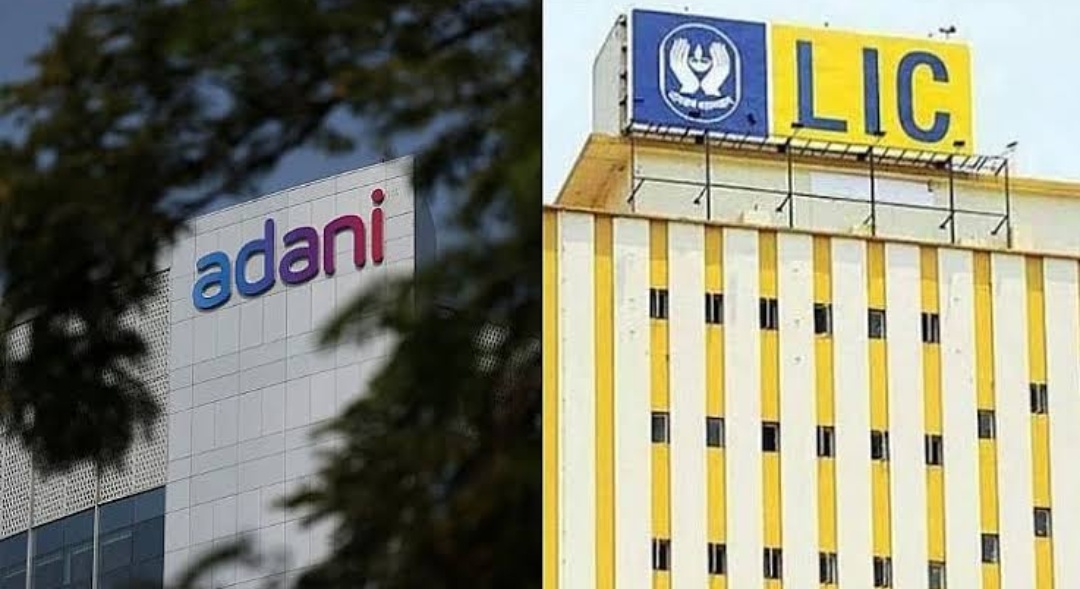
The Modi government has earned a reputation for favoring major corporate houses in the country. When it comes to the Adani Group, however, the relationship is known to be exceptionally close. A report published by The Washington Post confirms that the Union Ministry of Finance allegedly pressured the Life Insurance Corporation of India (LIC) the country’s largest life insurance company to invest huge sums in Adani Group bonds in order to help the conglomerate clear its debts.
According to internal documents from the Ministry’s Department of Financial Services, the government exerted pressure on LIC in May this year to invest $3.9 billion (₹33,000 crore) in bonds issued by the Adani Group. This development follows the 2023 Hindenburg Research report, which accused Adani Group of manipulating market regulations and artificially inflating its share prices. Currently, Adani Group is facing criminal investigations from the US, Department of Justice. Allegations have also surfaced that shell companies from tax havens invested billions of rupees into Adani Group firms in violation of market regulations established by SEBI (Securities and Exchange Board of India).
However, with the support of the Central government and the Finance Ministry, SEBI has failed to conduct an impartial investigation into these allegations. In 2024, US authorities once again brought criminal charges against the Adani Group. The charges claim that Gautam Adani and his associates engaged in fraudulent and illegal financial dealings by paying bribes. Despite these allegations, the Finance Ministry directed LIC to make large investments in Adani bonds. That same month, LIC purchased the entire $585 million (₹4,950 crore) worth of bonds issued by Adani Ports, which the company used to repay its debts.
According to The Washington Post, representatives from the Finance Ministry, NITI Aayog and LIC jointly discussed these investments in Adani Group. Shockingly, the Finance Ministry described Adani as a “visionary industrialist’. It argued that LIC’s investment would not only demonstrate confidence in Adani Group but also encourage other investors to follow suit. The Ministry even claimed that Adani’s bonds offered more attractive returns than government securities issued by the Reserve Bank of India (RBI). However, analysts who have long studied LIC’s investment strategies strongly disagree. They point out that LIC has always prioritize safety over high returns, given that it manages the hard earned savings of millions of middle class Indians. Traditionally, LIC has preferred to invest in government securities precisely to ensure this security. Considering Adani Group’s heavy debt burden and its uncertain financial stability, many view LIC’s massive investment in its bonds as reckless and politically driven.
Critics argue that this was not a normal market investment but a deliberate attempt to use LIC’s name and credibility to attract other investors to Adani’s bonds and it worked. Within a month of LIC’s purchase, US based Athene Insurance invested $750 million in Adani Ports bonds. After LIC’s purchase in May 2025, Adani Group issued an additional $10 billion worth of bonds, of which Indian mutual funds, banks and insurance companies bought around $1.625 billion (₹13,750 crore). Notably, neither the State Bank of India nor private banks like ICICI or HDFC invested anywhere near the scale that LIC did.
As of March 2025, LIC held life insurance funds worth ₹47.85 lakh crore, a reserve intended for policyholder claims making it the largest such corpus in India, and among the biggest globally. LIC’s fund has been growing by about 10% annually, reflecting its historically disciplined investment approach. The fact that LIC was made to buy Adani bonds, despite risks, has caused widespread public concern. LIC, however, denied The Washington Post’s report, calling it baseless and claiming the investments were approved by its board. The mainstream media, which has generally supported the Modi government and the Adani Group, defended LIC’s decision but avoided the key question why the government needed to intervene in an autonomous financial institution’s decisions.
Adani Group operates across multiple sectors ports, airports, roads, cement and more and is already one of India’s biggest conglomerates. So why did LIC need to invest in it? How can this be considered a sound business decision? While some argue that LIC has also invested in companies like Tata, Reliance and ITC, those investments were made gradually over decades unlike the rapid and politically charged investments in Adani Group that began after Modi came to power in 2014. Market experts describe Adani’s meteoric rise as a bubble. Given LIC’s long-term financial obligations and its responsibility to millions of policyholders, it cannot afford to take such high-risk bets. The claims that LIC will earn ‘bumper returns’ from these bonds are highly doubtful. LIC’s core mission is to protect public money, not gamble it for speculative profits.
The Modi government, however, has consistently brushed aside every allegation against the Adani Group including those involving fake invoices and financial irregularities. In light of these serious concerns, many are calling for a Joint Parliamentary Committee (JPC) investigation into the government’s role in pressuring LIC to invest in Adani Group.