

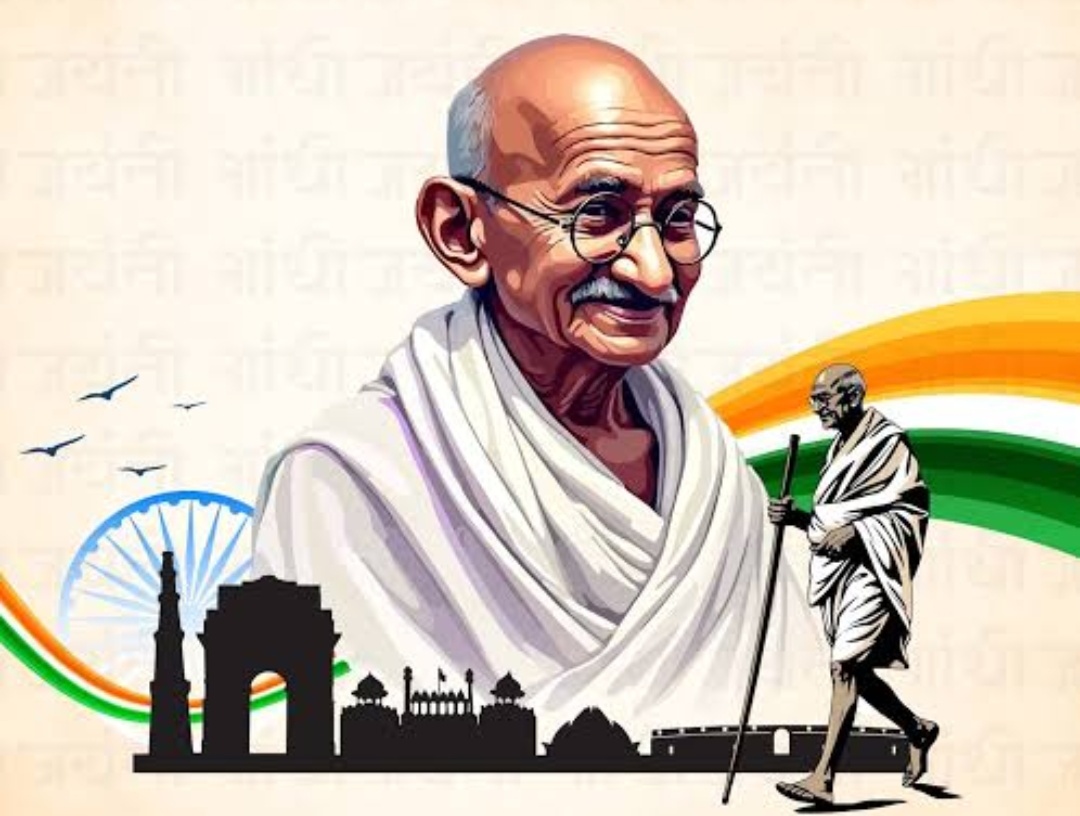
Mahatma Gandhi spent the last three decades of his life striving to secure India’s independence from British colonial rule. During that period, he rarely wrote or spoke about his vision of ‘what independent India should be..??’. However, in March 1922, he proposed a short, concise definition of Swaraj. Today, we once again need to remember it and draw inspiration from it. The eradication of untouchability, the production of khadi, Hindu-Muslim unity, and the practice of nonviolence were the foundations of the Swaraj he envisioned. If even one of the four corner pillars on which the edifice of Swaraj always rests is removed, the entire structure will collapse. Let us examine in greater detail the four key elements that formed the basis of the nature and character of Swaraj. Today, we may understand ‘eradication of untouchability’ in a broader sense as social justice. Social justice means completely eliminating not only caste-based inequalities but also gender inequalities. Unlike other upper-caste leaders in the Congress such as Nehru, Patel, and Bose, Gandhi had a sharp and comprehensive understanding of how the evil of untouchability could obstruct India’s struggle for independence. He condemned untouchability as a ‘sin’ and those who practiced it as ‘destroyers of Hinduism’.
Gandhi also paid complete attention to women’s emancipation. In a speech delivered in 1917, Gandhi said, ‘Women are companions of men and equal in mental capacity. She has the right to participate in all the activities of men. In matters of freedom and independence, women have exactly the same rights as men’. Women played a crucial role in all the satyagrahas Gandhi conducted against colonial rulers. Gandhi the Mahatma’s agenda of social reform had limitations. He coined the term ‘Harijan’ to refer respectfully to untouchables. Its replacement today by the term ‘Dalit’ is a sensible change in keeping with the times. Gandhi’s views on women’s participation in the traditional economic system were ambivalent. Nevertheless, in opposing caste oppression and gender discrimination, and in working to eradicate them, he was far more progressive and ahead of all his contemporary nationalists. Let us look at the special importance Mahatma gave to khadi production. During Gandhi’s time, and from then until today, khadi production has been viewed with disdain. Accepting khadi is considered a rejection of industrial economic activities that promote economic development.
However, the path of economic development currently followed by independent India is causing many problems (concentration of wealth, lack of dignified, meaningful employment opportunities, environmental destruction). In this context, Gandhi’s economic ideas still have some relevance. The khadi movement he led gave importance to the dignity of labour and local self-reliance. He often wrote about how important it was to use nature and natural resources judiciously. In many ways, Gandhi was a precursor of environmentalism. Gandhi’s ideas and practices can greatly help us in preventing air and water pollution, soil degradation, and effectively confronting climate change. The third pillar of Gandhi’s Swaraj is ‘Hindu-Muslim unity’. He understood the importance of religious harmony in nation-building from his life experiences in South Africa. If Gandhi had succeeded as a lawyer in Bombay itself, almost all his clients and friends would probably have been Hindus. However, he failed as a lawyer both in Bombay and Rajkot. He went to Durban in South Africa to resolve a dispute between Gujarati Muslim merchants. There he became a social worker. He worked extensively to resolve the problems of Indians living abroad. In this work, Parsis, Muslims, and Tamils gave him complete help and cooperation. Gandhi understood how important it was to respect religious and linguistic pluralism in developing a strong nationalism. While in Johannesburg jail in 1908, he wrote, ‘Among the Indians agitating against white rulers in South Africa, there are no distinctions of Hindus, Muslims, Parsis, Christians, Bengalis, Gujaratis, Punjabis. We are all Indians. We are fighting for India’. After being released from prison, Gandhi told the Indians of Johannesburg, ‘If the two eyes (Hindus and Muslims) remain unharmed, you will prosper. If the followers of both religions remain united, you yourselves will become the rulers of India’.
After returning to India, he worked with the same firm convictions. Despite making great efforts for religious harmony, Gandhi failed to prevent the partition of the country. He worked with determination to ensure that Muslims who remained in India after August 1947 received equal rights alongside Hindus. To protect the rights of minorities, he undertook fasts in Calcutta in September 1947 and in New Delhi in January 1948. Between these two fasts, on November 15, 1947, speaking at a meeting of the All India Congress Committee in New Delhi, he appealed to all party members to remain committed to the fundamental objectives of the Congress. He said that working for Hindu-Muslim unity was intrinsic to the nature of the Congress, and urged that the Congress should continue its efforts of the previous six decades in this regard in a more comprehensive manner. Let us look at the practice of nonviolence, the fourth pillar of Gandhi’s Swaraj. Gandhi was a prophet of nonviolence. He gave importance to nonviolent methods in public life. Until his final breath, he practiced nonviolence in thought, word, and deed. As part of his work for the rights of Indians in South Africa, Gandhi went to London in the summer of 1909. In those days, an Indian youth killed a British high official by shooting him. This incident horrified Gandhi. He wrote: If the British leave India because of such violent acts, who would become the rulers of the country in their place? The only answer to this question: murderers. Whether those murderers are white or black, India will not and has not benefited from their rule’. Two decades after the London incident, Gandhi had to confront the ‘worship of violence’ among young revolutionaries in India. Those young revolutionaries believed that killing white officials was the only way to drive the British out of the country. Gandhi convinced those young revolutionaries that ‘a dependent country cannot gain independence through isolated acts of daring’. He said that the organized constructive efforts of thousands of women and men, young and old, were necessary to build the temple of freedom. He acknowledged the courage and bravery of young revolutionaries who did not hesitate to sacrifice their lives for the country’s independence or for social change. However, Gandhi believed that the world had grown weary of armed revolutions. The Mahatma said that effective change could be achieved through nonviolent struggle. More than a hundred years have passed since Gandhi gave his distinctive definition of Swaraj. So how do that idea and its four pillars stand in the present era? Gandhi himself never considered the functions and responsibilities of the governmental system of independent India.
However, he would certainly have been shocked by the punitive laws currently in force and their misuse to keep those who criticize methods of governance in prison for years. He would certainly have been horrified by the speeches and comments of the Home Minister, Prime Minister, and Chief Ministers of Assam, UP, West Bengal, and other states that create religious divisions among the people of the country. He would certainly have appreciated movements that are proceeding on principle with complete commitment to nonviolent methods, especially protests against the Citizenship Amendment Act, farmers’ struggles, environmental movements, and the recent student protests. Equal rights for Dalits, women, and minorities, an equitable, sustainable model of economic development, and practicing nonviolence in thought, word, and deed- these remain the most essential conditions for freedom. In present-day India, each of the four pillars of Gandhi’s Swaraj has weakened. They have been weakened not only by government actions but also, in many instances, by the actions of citizens. The structure of Swaraj envisioned by Gandhi has not yet collapsed, but it is by no means strong or stable.