

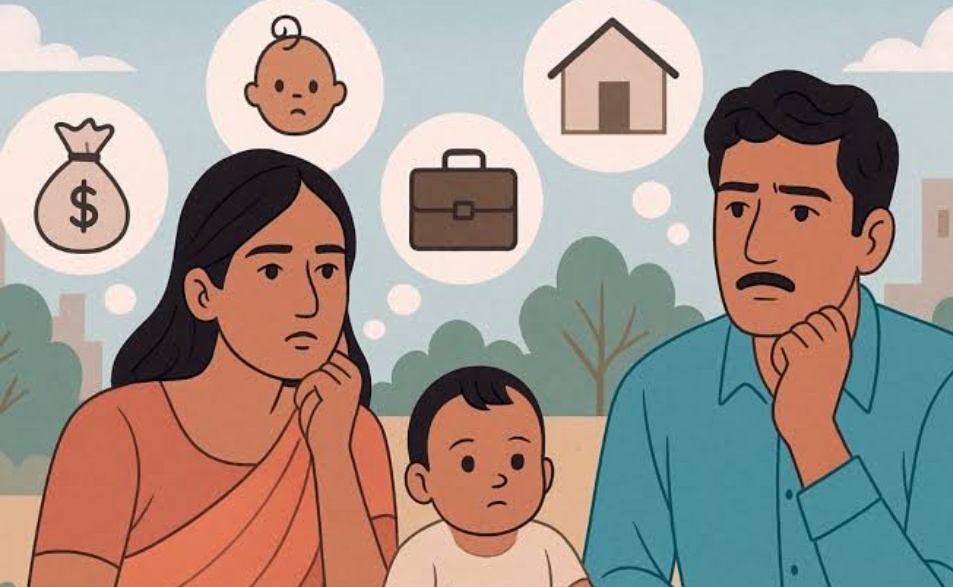
Under the central government’s rule, economic growth figures are shining only on paper. But the situation of ordinary Indians in the country appears quite different. While the incomes of middle-class families are not increasing much, expenses on education, healthcare, transportation, and daily necessities are rising sharply. As a result, household consumption is now being driven not by income but by debt. On the other hand, the wealth of the affluent class is growing rapidly. The increasing reliance on cash transfers instead of public services is raising crucial questions about the country’s economic policies. Under both central and state governments, the economic condition of India’s middle class is gradually deteriorating. Once, when employment and wages increased, household consumption would increase. Now, even if income does not rise, expenses do not stop. As a result, people are being forced to take loans to continue meeting their living needs. At the same time, the wealthiest section of the country is rapidly increasing its wealth and raising purchases of high-value homes, cars, and other goods. This raises questions about standards of quality of life.
● Middle-class market weakens.
For the past two decades, middle-class consumption has been the main source of India’s economy. The market expanded from shampoo and packaged food to two-wheelers, cars, and ACs. Now that purchasing power is slowing. The volume sales growth of Fast Moving Consumer Goods (FMCG) products, which was 11-12 percent in 2011, fell to just three percent in 2026. The growth of consumer goods has also declined from double-digit levels to mid-single digits.
● Jobs are the key problem.
Unemployment has risen sharply in the country over the past decade. Around 80 lakh people enter India’s job market every year. But only a very small number are getting full-fledged white-collar jobs. According to research by Azim Premji University, only four percent are getting full-fledged white-collar jobs. With job postings declining in the IT and BPO sectors and the impact of artificial intelligence (AI) increasing, pressure on white-collar jobs is growing further. Analysts say this is due to the weak policies of the Modi government at the Centre. Rise of the affluent On the other hand, a new wealthy class is rapidly emerging in the country. Entrepreneurs from small and medium-sized cities are creating enormous wealth through technology. Its impact is clearly visible in real estate. The share of homes priced below Rs 1.5 crore was 85 percent in the first quarter of 2022, but fell to 47 percent by the first quarter of 2026. The share of homes priced between Rs 1.5 crore and Rs 4 crore, however, increased from 14 percent to 44 percent. This shows how the rise of the affluent is taking place under the BJP-led NDA government. Private final consumption expenditure increased from 5.8 percent in the 2025 financial year to 7.7 percent in 2026. In the first quarter of 2026-27, it was recorded at 7.1 percent. However, behind this increase, the expansion of loans has become a more important factor than household incomes. Vehicle loans increased by 18.8 percent, while gold loans rose by a whopping 88.1 percent. At the same time, the growth of credit card outstanding fell to 2.3 percent, and the growth of consumer goods loans fell to 0.4 percent. This means people have not stopped spending, but the real question is where the money for that spending is coming from.
● Governments turn towards cash transfers.
Pressure is also increasing on the financial condition of governments. According to the 2026-27 budget estimates, the central government’s interest payments have reached Rs 14.04 lakh crore. With a major share of government revenue going toward interest payments, spending on public services is declining. On the other hand, schemes providing cash transfers to women and low-income groups are expanding across the country. While providing immediate financial assistance offers temporary relief to poor families, economists say there is a risk that it could have adverse effects in the long term. Meanwhile, the central government is not paying as much attention to strengthening government schools, hospitals, and employment opportunities that are crucial to the people.
● In whose hands is consumption.
A clear division is now visible in India’s consumption system. At the top, spending by the affluent is increasing. Meanwhile, the middle class is relying on loans. For lower-income groups, cash transfers are becoming the basis. Economists warn that if consumption growth continues without strengthening jobs, wages, and public services, that growth cannot be considered sustainable. Consumption through debt The expenses of middle-class families are not matching their incomes. Expenses on education, healthcare, transportation, housing, and daily necessities are rising. Income is not increasing proportionately. As a result, families are turning to loans. Dependence on debt is making the future more complicated. It is worrying that statistics indicate that, excluding housing loans, household debt in the country has reached the highest level in the world as a share of GDP.