

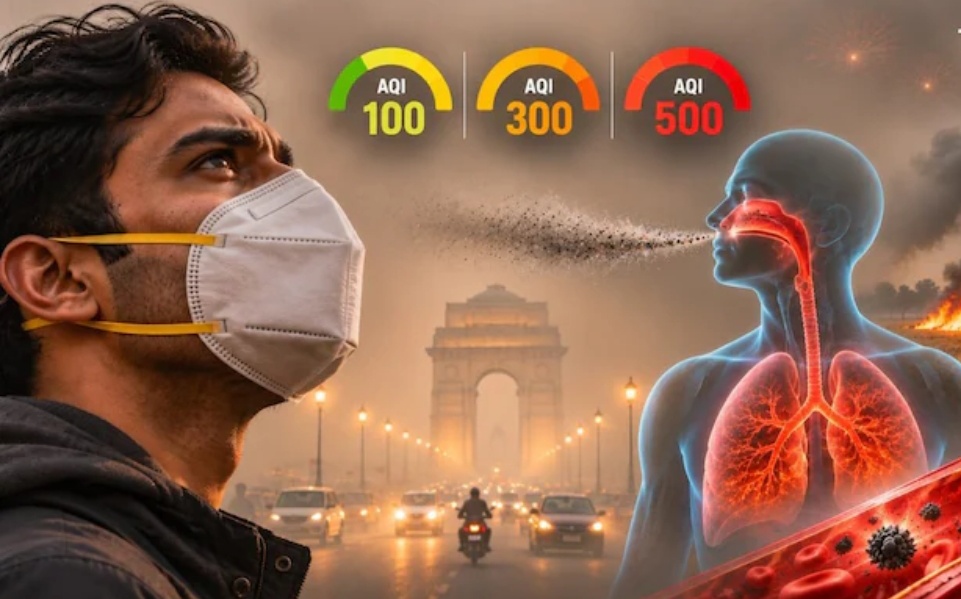
Just as food and water are essential for human survival, clean air is equally important. It is deeply alarming that the very air that sustains life is now turning toxic. Major cities across the country are gradually falling into the grip of pollution. Until recently, air pollution was commonly associated with the national capital, Delhi. What was once largely confined to industrial and heavily congested areas is now spreading to residential localities and even rural regions. Festivals, which are meant to be celebrated with joy and enthusiasm, are increasingly becoming sources of severe pollution. The sharp deterioration in air quality in major cities such as Delhi and Hyderabad following the Diwali celebrations reflects the seriousness of the environmental crisis. On the morning of November 10, Delhi’s Air Quality Index (AQI) reached 366. In some parts of the city, it climbed as high as 460. An AQI between 301 and 400 is classified as ‘Very Poor’, while a reading between 401 and 500 is categorised as ‘Severe’.
According to these figures, the air people breathe in several parts of Delhi has become a serious threat to their health. Reports have also indicated a rise in pollution levels in Hyderabad. Between 9 pm and 10 pm on Sunday night, the AQI crossed 500 points in several areas. The average AQI of Hyderabad city is 80 points. This clearly indicates that the concentration of air pollutants had doubled compared to normal days. As a result, people suffering from asthma and respiratory ailments faced severe difficulties. It is distressing that firecrackers burst for festive celebrations have ultimately become a threat to public health. The annual market value of the firecracker industry in India during Diwali is estimated at approximately Rs. 7,000 crore. The bulk of firecracker purchases take place during the Diwali festival. More than 80 per cent of the sales originate from Sivakasi in Tamil Nadu. While the factory manufacturing value accounts for Rs. 2,000 crore, the remaining Rs. 5,000 crore comes from transportation, wholesale and retail businesses. Delhi and Bengaluru account for business worth around Rs 300 crore, while Hyderabad’s firecracker market is estimated at Rs 150 crore to Rs 200 crore. Notably, firecracker sales in Karimnagar district alone are estimated at approximately Rs 8 crore. Although lakhs of families benefit from this industry, many families involved in firecracker manufacturing face accidents and serious hazards during production. Had greater attention been paid to manufacturing environmentally friendly green crackers, the situation might have been different. Apart from air and noise pollution, several fire accidents were also reported. Across the country, 23 people lost their lives in fire-related accidents. Some people also suffered eye injuries and lost their eyesight. People already struggling with various problems are being subjected to an additional burden due to the pollution caused by firecrackers during festivals. Smoke emitted by vehicles, industrial emissions, dust from construction activities, dust accumulated on roads, open burning of garbage and the burning of agricultural waste are among the major causes of air pollution. In addition, reduced wind speeds during winter and prevailing weather conditions cause pollutants to remain trapped close to the ground. Closing schools when air quality reaches dangerous levels, advising people to wear masks and warning them against outdoor exercise are only temporary relief measures, not permanent solutions. In 2019, when pollution reached alarming levels, people were forced to wear masks whenever they stepped outside. Now, it has become a situation where wearing masks every day seems unavoidable. What is the point of temporary measures if the root causes of pollution are not eliminated?
Since the Narendra Modi government came to power at the Centre, there have been no significant measures to safeguard public health in this regard. It cannot be said that the country lacks laws, policies or institutions to control pollution. In 2018, the Supreme Court issued important directions regarding the use of firecrackers during Diwali. It called for the promotion of green crackers that emit lower levels of pollution and made it clear that firecrackers manufactured using prohibited chemicals should not be sold. A special commission was also established in 2021. Despite the existence of so many institutions and regulations, the fundamental question remains: why has pollution not been brought under control? Pollution Control Boards should not remain mere agencies for collecting statistics. The perception that Diwali celebrations are incomplete without the deafening sound of firecrackers must change. Environmental protection should not remain confined to announcements and publicity; it must be translated into concrete action. Otherwise, in the future, our cities may continue to shine with lights and grandeur, but the very air that we breathe freely could become a scarce commodity.