

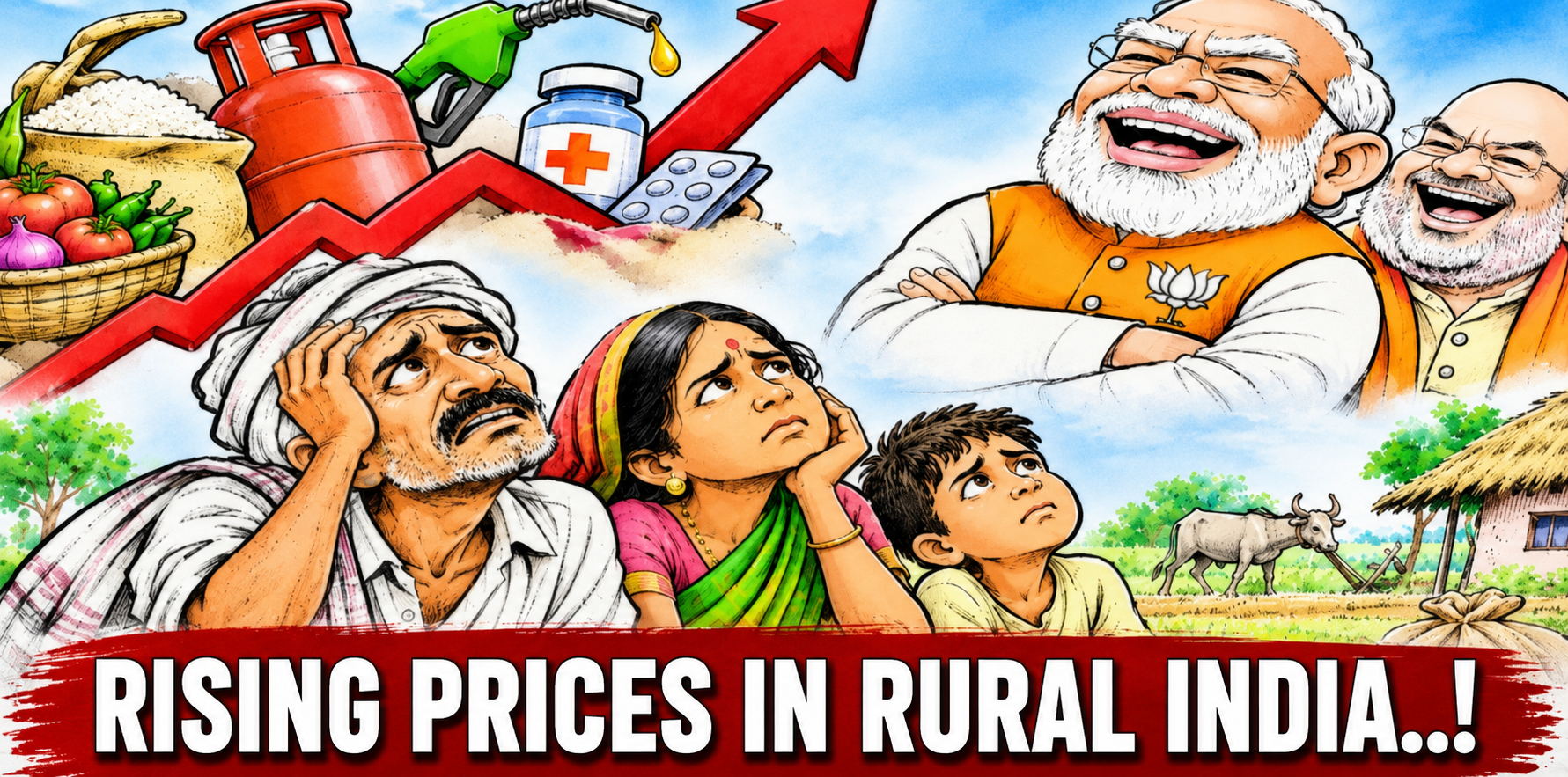
Although the Narendra Modi-led Central Government boasts that the country’s economy is progressing rapidly, the lives of rural families are becoming increasingly difficult. Rising prices of essential commodities, stagnant incomes and declining savings capacity are forcing people in villages to depend on loans to meet their daily needs. A recent survey conducted by the National Bank for Agriculture and Rural Development (NABARD) has highlighted this situation. The survey collected information from 6,000 households across 600 villages in 28 states and Jammu and Kashmir. Rural inflation rose to 6.08 per cent in September, compared to 5.24 per cent in August and 4.84 per cent in July. This indicates that the burden of rising prices in rural areas is steadily increasing, adversely affecting the purchasing power of households.
● Income Increased for Only a Few.
Only 27.1 per cent of households reported an increase in their income over the past year. Notably, this is the lowest figure since NABARD began conducting the survey. In November last year, the figure stood at 42.2 per cent. Meanwhile, 20.5 per cent of households reported a decline in income, while 52.4 per cent said their income remained unchanged. Even among households that experienced an increase in income, the average growth was limited to just 10.5 per cent. These figures indicate that incomes are not rising at the same pace as prices.
● Where Is the Scope for Savings?
The share of savings in rural household incomes has fallen to its lowest level ever. At present, households are saving only 12.6 per cent of their monthly income, compared to 16.8 per cent in September 2024. Nearly 65 per cent of their income is being spent on essential commodities and other consumption expenses, while another 13.2 per cent goes towards loan repayments. As many as 32.1 per cent of households reported a decline in their financial savings. The proportion of households whose investments declined also reached a survey high of 20.2 per cent.
● Half of the Income Spent on Food.
Food accounts for 53.5 per cent of the monthly consumption expenditure of households. Education and healthcare account for 24.1 per cent, while fuel-related expenses such as cooking gas and transportation consume another 16.6 per cent. People expect inflationary pressures to intensify further. Prices are expected to rise by 5 per cent over the next three months and by 5.9 per cent over the next year. This situation poses a major challenge for the government, which needs to reduce the burden of rising prices on ordinary people.
● Share of Welfare Assistance Declining.
Government subsidies and direct financial transfers account for an average of 8.3 per cent of the monthly income of rural households. A year ago, this share stood at 9.3 per cent. Although assistance is being provided through schemes such as PM-KISAN and the Pradhan Mantri Garib Kalyan Anna Yojana, the support appears insufficient to help families overcome their overall financial difficulties.
● Confidence in the Future Is Declining.
Around 67.9 per cent of households expect their incomes to increase over the coming year. However, optimism regarding employment opportunities has declined compared to previous surveys. As many as 94.8 per cent of respondents believe that employment conditions will either improve or remain unchanged. Regarding rural development, 45.3 per cent of households gave top priority to roads, followed by education and electricity. Overall, there appears to be a gap between the Central Government’s claims about the country’s economic growth and the actual financial conditions faced by rural households. With incomes failing to increase adequately, expenses remaining high, savings declining and debt burdens mounting, the NABARD survey highlights the need for measures to provide relief to rural communities.
● Loans Becoming the Only Option.
Rising prices and stagnant incomes are pushing rural households towards borrowing. The proportion of households reporting an increase in their debt rose from 28.7 per cent in July to 32.4 per cent in the latest survey. As many as 22.1 per cent of households are borrowing money from private individuals and other informal sources. The average annual interest rate on such loans stands at 18.3 per cent. Some borrowers are paying interest rates of 30 per cent or even higher. Contrary to the claims that loans are readily available at lower interest rates through public sector banks, a section of rural households continues to bear the burden of high-interest borrowing.