

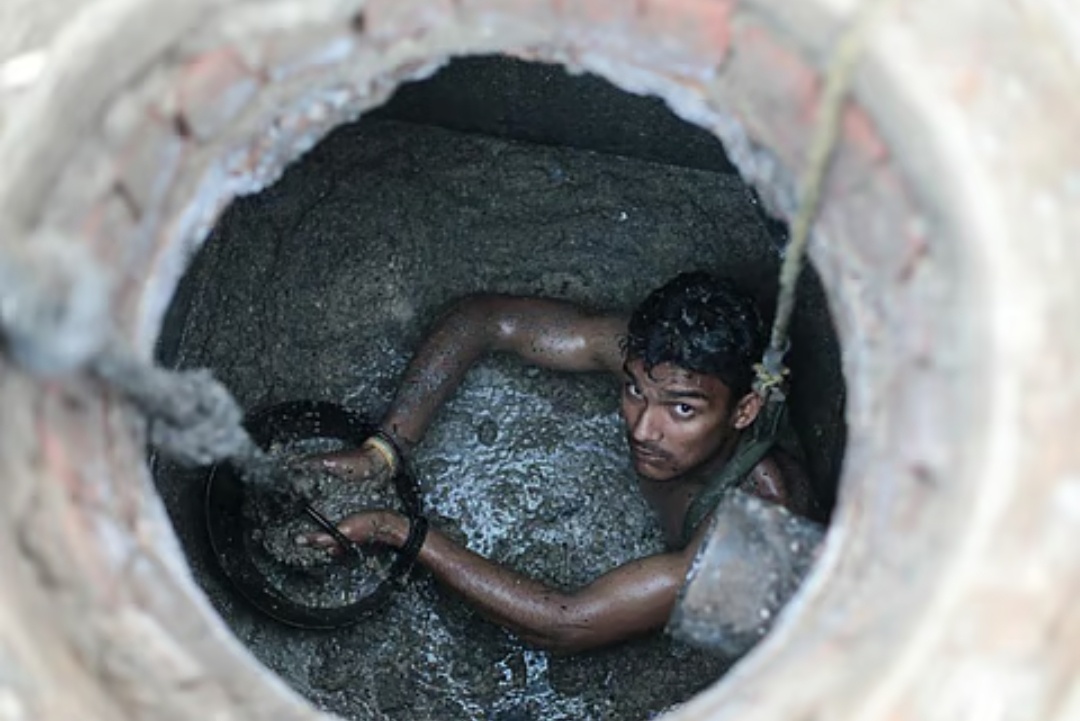
It is extremely inhuman that even today, in our cities, people are still forced to clean human excreta by hand. What makes the situation even worse is that those engaged in this work are employed on a contractual basis without any job security. More disturbing still is the fact that the vast majority of these workers belong to Dalit communities. Despite repeated demands for regularisation of their jobs and the abolition of manual scavenging, there has been little to no progress. Instead, harassment, oppression and discriminatory treatment of these workers have become commonplace.
Statistics indicate that 593 workers died of suffocation in sewer pits in the national capital, New Delhi, between 2021 and July 2026 alone. Recently, sanitation workers, along with the families of those who had lost their lives, staged a massive protest near Jantar Mantar, demanding an immediate end to the inhuman practice of manually cleaning septic tanks and the complete mechanisation of sanitation work. It is a serious failure of our governance system that the very workers who keep our cities clean are forced to live with insecurity and danger. To pressure governments into changing this situation, the working class is preparing for another militant struggle on December 1, 2 and 3.
Following the introduction of economic liberalisation policies, contractual employment has expanded in both the public and private sectors, replacing permanent jobs. As a result, workers have been deprived of job security, equal pay for equal work and social security benefits. Sanitation workers, who perform work that is as demanding as, or even more dangerous than, that performed by permanent employees, receive much lower wages. Many of them are also denied health insurance, pensions and other benefits. Governments are washing their hands of their responsibility to provide better sanitation services to the public by handing over these duties to contractors. In services that should be delivered using public funds, the interests and profits of contractors are increasingly being prioritised. Delays in wage payments, staff shortages and excessive workloads are causing severe hardship for workers. According to the Annual Survey of Industries, contract workers now account for 42 per cent of the workforce in the manufacturing sector. This figure is more than double the corresponding figure for 1999–2000. The situation is even more evident in the sanitation sector. Although the government has not published centralised data on this issue, a study by Dhamma Darshan Nigam and Shiva Dubey of FLAME University in Pune indicates that, across cities in India, between 50 and 80 per cent of sanitation workers are employed on a contractual basis.
The wage gap between contract workers and regular employees is substantial. Even more alarming is the fact that the caste system continues to influence the sanitation sector. While Dalits and members of other socially marginalised communities perform most of this work, those with economic and political influence exercise control over the contractual system and reap its benefits. Labour recruitment practices dating back to British rule and service relationships rooted in the feudal era continue to manifest themselves in new forms of caste-based and economic exploitation under the modern contract system.
For example, the Greater Visakhapatnam Municipal Corporation employs approximately 4,800 sanitation workers, of whom 3,800 around 80 per cent are Dalits. Their wages are less than half those of permanent workers performing the same work. While the starting salary of a permanent worker exceeds ₹30,000, contract workers receive only ₹15,000. Through sustained efforts under the leadership of the Centre of Indian Trade Unions (CITU), they have also secured an additional ₹6,000 as a health allowance.
Restricting sanitation work to certain communities on the basis of caste is contrary to the principles of social equality. Treating the removal of human excreta and the cleaning of sewage drains among the most dangerous forms of work as the responsibility of specific social groups is inhuman. Society depends on the labour of sanitation workers to maintain cleanliness, yet it continues to fail in providing them with even basic dignity and safety. Initiatives such as the Swachh Bharat Mission, solid waste management programmes and mechanisation should not only improve sanitation but also protect the health and safety of workers. However, problems such as the failure to segregate waste at source, the lack of adequate machinery and deficiencies in management are placing an additional burden on sanitation workers. Technology should reduce their workload and save their lives; it must not become a tool for exploiting them as cheap labour. Yet, even where machinery is available, workers continue to be sent into sewers and made to perform hazardous tasks without protective equipment. This directly contradicts the very objectives of modernisation.
If the responsibility for providing sanitation services to the public rests with the government, then a crucial question arises: who is responsible for the safety of the workers delivering those services? The government cannot escape its responsibilities simply by handing over work to contractors. Monitoring the functioning of contracting agencies, ensuring timely payment of wages and safeguarding workers’ rights remain the government’s responsibility. The historical relationship between caste and occupation continues to persist in new forms under the modern contractual system. The ‘Contractor Raj’ is not merely a method of employment. It is a system that weakens government accountability, makes workers labour cheaper and perpetuates caste inequalities. Transforming this system requires the implementation of policies that protect workers rights. Therefore, regularisation of employment is not merely a matter of wages; it is also a struggle for social justice that challenges caste-based occupational inequality. Workers rights are the foundation of sanitation reforms. The services of contract workers must be regularised, and they must be brought under a system of direct government recruitment and wage payment. Timely wages, job security, health insurance and social security must be guaranteed. Labour laws must be strictly enforced. Mechanised methods must be prioritised for cleaning sewers and underground drainage systems. Using technology to prevent sanitation workers from risking their lives in hazardous conditions is a true measure of social progress.
Above all, society’s attitude of linking sanitation work with caste must change. The cleanliness of modern cities should be measured not merely by how clean their streets are, but also by whether the workers who maintain them enjoy dignity, safety and equal rights.