

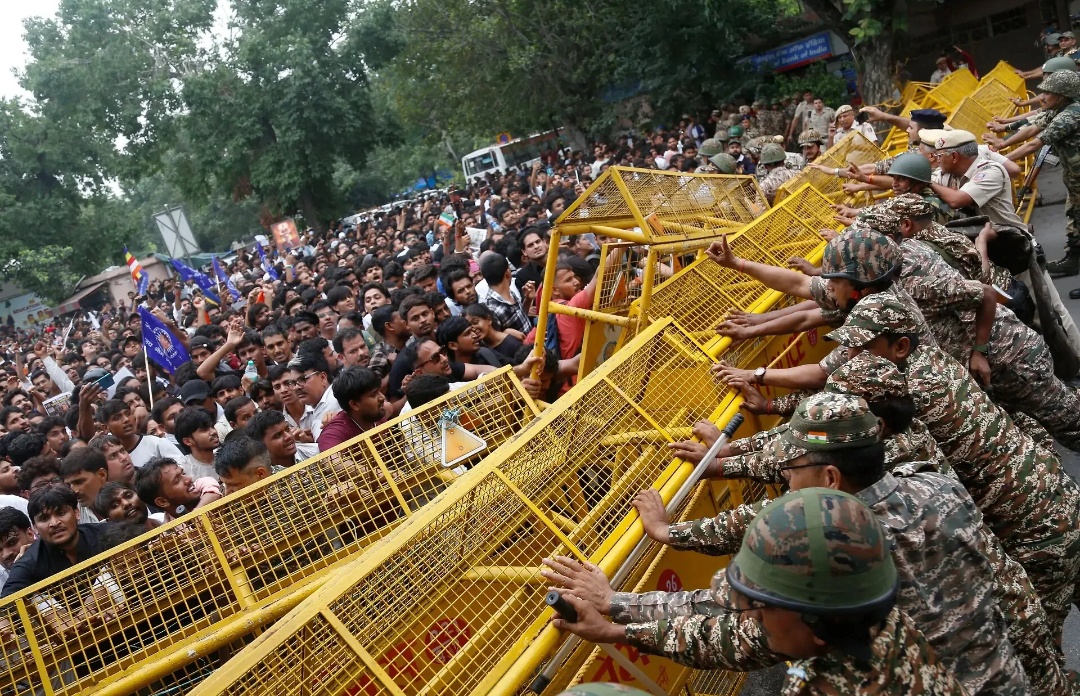
The real test of power in a democracy does not end with victory in elections. That power must prove its moral legitimacy by answering the questions raised by the people, maintaining confidence in constitutional institutions, and respecting differing opinions. However, against the backdrop of revisions to voter lists, doubts being expressed about the functioning of the Election Commission, and political forces taking to the streets in protest over these issues, developments in Delhi have once again brought key questions about the democratic system to the forefront. Why did the situation arise in which massive restrictions had to be imposed to control a protest? Is it justified to prioritize restricting people’s movements over addressing their doubts? The Supreme Court’s remark, ‘Why use a hammer to kill a fly?’ reminds us of the seriousness of these questions. The Election Commission is not merely an institution limited to conducting elections. It is a constitutional body that protects the right to vote, which is the foundation of the country’s democracy. Therefore, its decisions, policies, and actions must inspire greater public confidence. When political parties raise questions about the electoral process, it is not enough to dismiss them as mere political allegations. It is necessary to examine transparently how much truth the allegations contain and whether the doubts are supported by evidence. The Special Intensive Revision process of voter lists must also follow the same standard. Just as it is important for the names of eligible voters to appear on the list, it is equally important that the process of removing ineligible names be carried out in accordance with the rules. However, adequate precautions must be taken to ensure that the names of eligible citizens are not mistakenly removed in the process. Safeguards such as providing reasons for removing names, accepting objections, and offering an opportunity for reconsideration must necessarily be in place. Voter list revision is not merely an administrative process it is a responsibility linked to a citizen’s democratic right. In this context, the restrictions imposed during the protests in Delhi have sparked further debate. Measures such as the suspension of mobile internet services, the closure of metro station entrances, and restrictions on transport services affect people’s everyday lives. Maintaining law and order is the government’s responsibility. However, the measures taken to fulfill that responsibility should not go beyond what is necessary. Measures intended to address a specific threat are not the same as those that broadly affect ordinary people’s travel, communication, and daily activities. If action needs to be taken against protesters, lawful procedures must be followed. Along with ensuring that public safety is not threatened, the right to express one’s views peacefully must also be respected. If, while speaking about democratic rights on the one hand, opportunities to exercise those rights are extensively restricted on the other, there is a risk of growing public discontent. A balanced approach can be adopted by ensuring that people’s movement is not disrupted, emergency services are not obstructed, and suitable places are provided for holding protests. The underlying meaning of the Supreme Court’s remark also reminds us that there must be a balance between the severity of measures, their necessity, and their impact. The fact that law enforcement agencies have powers does not mean that there should be no limits on their use. Every restriction must have a reasonable justification, and that justification must be explainable to the public. It is also necessary to examine whether the measures taken are proportionate to the need and whether alternatives with less impact are available. When the Election Commission faces criticism, protecting the institution’s independence is just as important as maintaining public confidence in its functioning. Transparency in conducting elections, explanations for decisions, and impartiality in resolving complaints strengthen the democratic system.
● Not every allegation made by political parties can be assumed to be true.
At the same time, it cannot be concluded in advance that the allegations are being made solely for political gain. Doubts can be dispelled only by examining the facts against evidence and making the necessary information available to the public. In a democracy, protest is not an act against the system, but also an expression of public opinion that helps the system review its own functioning. If unlawful acts occur during protests, the law must take its own course. However, viewing every voice that raises questions peacefully with suspicion and treating restrictions that affect people’s everyday lives as an easy solution does not benefit democracy. Public trust cannot be acquired through force, it must be earned through honesty, transparency, and accountability. Ultimately, whether it is a dispute over voter lists, criticism of the Election Commission’s functioning, or restrictions imposed on protests in Delhi, all these issues remind us of the same fundamental principle. Public trust is more important than a display of authority when it comes to protecting democracy. Blocking questions does not eliminate doubts. Trust grows only when answers are provided. Barricades may close roads for some time.. but they are not answers to the questions that have arisen in people’s minds. The Election Commission must maintain public trust through its transparency, the government through its restraint, and the democratic system through its accountability. Because the real strength of democracy does not lie in the severity of restrictions. It lies in the respect accorded to every citizen’s vote,