

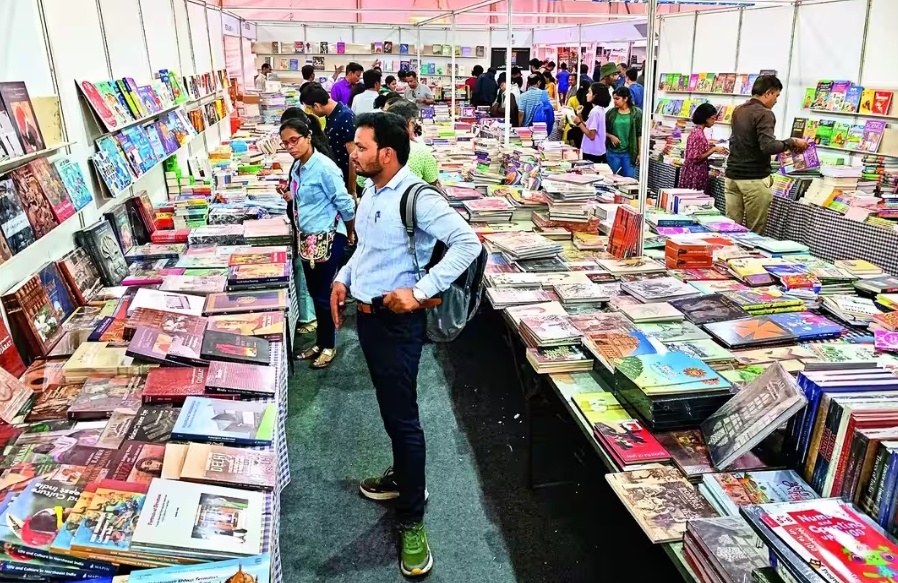
When a book fair or a festival of books begins, poets and book lovers are filled with immense joy. Just as people go wild over festive sales and shopping bonanzas, book lovers too become equally enthusiastic. After all, a book fair is truly a festival in its own right. One can browse through countless books to one’s heart’s content, buy a few, meet numerous poets, and listen to book launches and lectures. Book fairs give books a unique strength and visibility. Writers have placed great faith in the written word and the power of books, believing that the written word can illuminate consciousness, serve as a weapon for thought, and act as a compass reflecting democracy and politics. Literary figures such as Maxim Gorky, Gurram Jashuva, and Sri Sri clearly demonstrated whose side literature should stand on. Although the form of the written word and the book may change, their value has neither diminished nor will it ever diminish. That is the power they possess. The written word and movements are imprisoned; they are shifted from one prison to another, and sometimes released when they are barely breathing. Yet, despite all these attempts, the written word survives with its last breath and sprouts again in the form of books. As an eminent person once said, the book has been reborn. It is true. Just as movements are suppressed using tear gas, smoke grenades, and water cannons, similar efforts are made to suppress books, crush them, and bury them forever. Yet, like a blazing rocket, the book rises again and again, soaring into the sky.
● This is the inherent nature of the written word and the book.
For generations, dictators have tried every possible method to destroy them. They may have achieved temporary victories, but they have never succeeded in securing a permanent victory. That is the power of the written word. Just as politics, money, and hatred often go hand in hand, movements, the written word, and books also move together. Whether we look at the freedom struggle, cultural movements, identity movements, or any other movement, we find people carrying the written word and books along with them. As the saying goes, a book is an ornament of the hand; it is an inseparable companion. Governments and those in power build expressways, bullet trains, and flyovers to serve commercial interests and please their favourites. Alongside them, even middle-class people make use of these facilities. But when it comes to books, whether in the form of songs, stories, plays, or any other literary expression, they invariably support movements and bring people closer together. At the same time, some people are doing their part to use books to create divisions among people. Book-post services are discontinued, while the prices of paper and printing continue to rise. Writers who once printed a thousand copies of their books are now printing only two hundred or even a hundred copies. And when they try to send those books by post, the expense is enough to make their hearts sink. Just as we cannot afford to buy everything we see displayed behind the glass counters of sweet shops, there are days when book lovers can only look at books from outside, pick them up and browse through them, and feel happy with that experience. They may finally leave the fair with a few books published by the Telugu Academy or other institutions, which are available at relatively lower prices. We must recognise that just as the effects of El Niño are being felt in our daily lives, the El Nino-like policies imposed by the system are also having a significant impact on books. The very meaning of the word aksharam (written letter) is that which does not perish – that which is imperishable. So, how can anyone hope to destroy it?
The system appears to follow a policy of pretending to preserve the written word while gradually destroying it; preaching lessons that weaken its spirit; making people accustomed to meaningless and submissive words; and finally, silencing them by cutting off their very breath. This seems to be the policy of the establishment. Yet, just as seeds dropped by birds in cracks in walls, on towering trees, and in crevices among rocks eventually germinate, books too continue to sprout without boredom, interruption, or exhaustion. Those who attempt to destroy the imperishable written word will eventually disappear without leaving a trace. This truth is deeply embedded in books themselves. Those who change laws with a single stroke of the pen often forget that the same written word is used to introduce oppressive laws overnight. They cleverly manipulate words to suit their interests and take pride in giving bizarre names to their schemes.
Today, the written word, carrying the spirit of courage and defiance, is rushing towards Jantar Mantar. That is the power of the written word. The written word is always awake. Anyone who thinks they can put it to sleep will be making a grave mistake.