

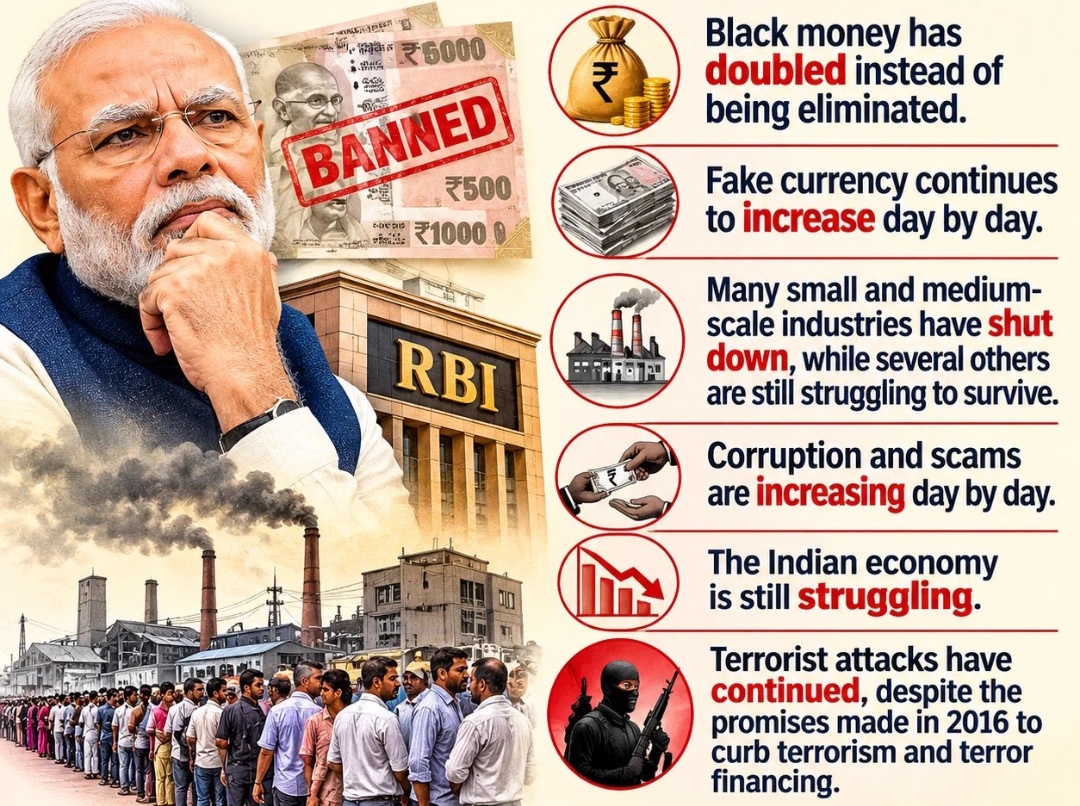
The demonetisation decision taken by the Modi government at the Centre a decade ago, claiming that it would completely transform the country’s economy, has left people with endless hardships and inflicted lasting wounds on the economy. The government had announced that the move would unearth black money, eliminate counterfeit currency, cut off financial resources to terrorism and eradicate corruption. Even today, however, there is no clear answer as to what it actually achieved in terms of these objectives. On November 8, 2016, at 8 pm, Prime Minister Narendra Modi announced the withdrawal of ₹500 and ₹1,000 currency notes. Declaring that these notes would cease to be legal tender from midnight, the decision triggered sudden economic turmoil across the country. At that time, these denominations accounted for 86.9 per cent of the currency in circulation. The government withdrew currency worth approximately ₹15.44 lakh crore. Critics argued that the government had failed to properly assess the consequences of such a massive decision. Even then, the Reserve Bank of India’s Governor, Raghuram Rajan, had warned that demonetisation would cause immediate economic losses and increase hardships for the public, pointing out that better ways existed to tackle black money. Nevertheless, the government went ahead with the decision. Contrary to the government’s claim that all black money would be brought to light, 99.3 per cent of the demonetised currency returned to the banking system. Currency worth only ₹10,720 crore did not return. The government overlooked the fact that a major portion of black money is held in the form of land, gold, benami properties and foreign bank accounts. The promise of curbing counterfeit currency also remained unfulfilled, as fake notes were subsequently detected even among the newly introduced currency. The objective of stopping the flow of funds to terrorism was also not achieved. The terrorist attack in Pahalgam on April 22, 2025, in which 26 people lost their lives, served as a reminder that terrorism continues to pose a serious challenge to national security. The promise of eradicating corruption also failed to materialise. The controversy surrounding electoral bonds in connection with political donations is one example of this. Ultimately, demonetisation imposed a huge burden on the economy. The shortage of cash reduced purchasing power and market demand. Production and sales slowed down, affecting the manufacturing, transportation and supply sectors. Economic growth was adversely impacted.
The government also had to incur enormous expenditure on printing, transporting and distributing new currency notes and recalibrating ATMs. These expenses came in addition to losses in production and employment. Following demonetisation, ordinary people were forced to stand in long queues outside banks and ATMs for days. Even those who had money in their accounts were unable to access it for their personal needs. People faced severe difficulties in arranging cash for weddings, medical treatment and everyday necessities. There were reports of several people losing their lives while standing in queues. However, the government’s statement in Parliament that it had no comprehensive figures on such deaths reflected a lack of accountability. The cash shortage severely affected agriculture, small-scale industries, petty businesses and the unorganised sector. Crores of workers lost their livelihoods, while numerous small businesses were pushed into distress.
On the other hand, large corporate companies with sufficient cash reserves, technological infrastructure and financial resources were able to withstand the crisis. As small traders and local producers weakened, competition for large companies declined, creating opportunities for business expansion. The expansion of digital payments also opened up new business opportunities for companies operating in that sector and for banks. While small traders and workers bore the brunt of demonetisation, large corporations gained relative advantages. It is true that digital payments and UPI transactions increased after demonetisation. However, the expansion of smartphones, internet connectivity and digital infrastructure also contributed significantly to this growth. Therefore, it is incorrect to portray the increase in digital transactions as an achievement of demonetisation. It is equally inappropriate to now consider imposing charges on these transactions. Far from achieving the goal of a cashless economy, the amount of currency in circulation has now exceeded ₹43 lakh crore.
Even after ten years, the question of what benefits of demonetisation actually brought to the country and its people remains a subject of debate. The objectives of eliminating black money, eradicating corruption, curbing counterfeit currency and stopping the flow of funds to terrorism failed to deliver the expected results. There is still no clear explanation of what was achieved by putting people through immense hardships and pushing the economy into a crisis. Economic policies should improve people’s lives rather than turn the public into subjects of economic experiments. This is the most important lesson that demonetisation has taught the country.