

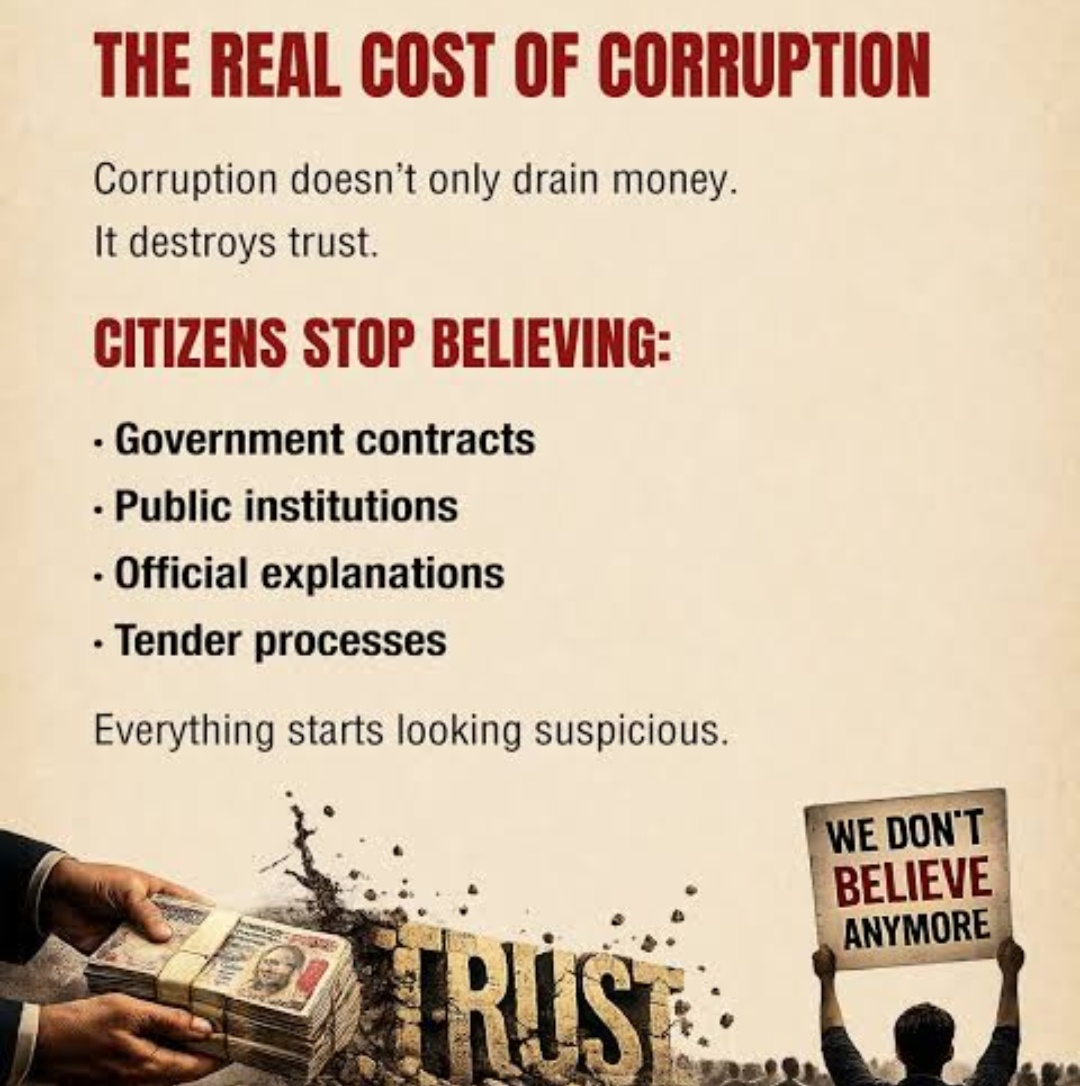
Corruption and bribery are two words that are often used interchangeably. Or are they really different words? The word ‘bribery’ as we use it today came into use in the 16th century. It was defined as ‘officials taking money for corrupt services’. Note that corruption is a part of that definition, but it is a much older word with Latin roots. Its meaning has very little to do with the exchange of money in return for something. It was defined as ‘rotting, breaking down, decaying’. Bribery is an individual act. But corruption, along with bribery, leads to the decay and destruction of institutions. This is the most important difference between the two. Crony capitalism. The Economist Intelligence Unit of ‘The Economist’ magazine produces a crony capitalism index every few years. It measures how much of the economy has been handed over to make individuals rich by shaping policies in their favour. In 2016, crony capitalism accounted for three percent of India’s gross domestic product, while in 2023 it doubled. This may or may not be bribery but it is certainly corruption because government authority and standards are being undermined and abused to enrich a select few.
● Democratic structure – the electoral system.
The state can also decay and rot in other ways. It is important to understand that for something or a system to rot, it must first have existed in its entirety. Indian democracy is a monumental project that took a long time to build. Books have been published detailing what a tremendous effort it was to introduce universal adult suffrage and how the first electoral rolls were prepared. They describe the enormous effort made to include everyone, including those who slept on platforms at night. Innovations such as election symbols were introduced to encourage even those who could not read to participate in voting. As election campaigns progressed, credibility increased. Parliament tried to curb defections by elected members. In 1994, the central power to arbitrarily dismiss state governments was withdrawn. Around the same time, we put an end to booth capturing and ballot-box manipulation, the biggest problems plaguing electoral democracy in India, with the arrival of voting machines(EVMs). Older-generation readers may remember this from some time before that. The Election Commission for the first time became an institution that asserted its authority over the government. This happened initially under the leadership of Seshan, an impartial and stubborn man. Although the government tried to restrain him by adding two new commissioners and turning it into a three-member committee, that independence continued. Progress means democratic institutions becoming more effective, trustworthy, and credible. Allowing such an institution to rot and decay for the selfish interests of individuals is corruption.
● Progress going backwards.
That progress has now gone backwards again in the matters of defections and dismissals of governments. Today, across India from west to east, even duly elected political parties are being bought. Election coverage shows that no matter whom people vote for, the result remains the same. The same people continue to control everything. The damage done to the institution of the Election Commission may become permanent, and the damage done to the electoral rolls may be just as lasting. A future government, no matter how well-intentioned, will have no way to undo what is happening before our eyes now and the damage that has already been done. Either the entire revision process must be scrapped (in which case this would also invalidate the elections held after the attack on the electoral rolls), or the names of the millions of people who have been deleted must be restored after they individually prove their identity to the government’s satisfaction.
● Under what rules can this be possible.
Will these new rules leave us with two levels of voters one cleared by officials, and another who came through a different route? This is not a problem that can be resolved so easily.
Remember that the destruction of the electoral rolls began without any immediate reason. No one has proved, or at least alleged, that India’s electoral rolls had been damaged beyond repair and that such a crude, complicated method, requiring people to prove their ancestry, was necessary to correct them. Just as our currency notes were thoughtlessly demonetised a decade ago, our electoral rolls are now being struck in the same way.
● Ruining existing institutions.
There is a saying in America’Don’t fix it if it isn’t broken or spoiled’. This saying tells us that if a system is working properly, there is no need to interfere with it unnecessarily. But malicious thinking does not take this saying into account. We are currently living by the principle, ‘If it isn’t broken, ruin it’. Despite the flaws in our democracy, when we engage with the world it is like a crown jewel in our crown. Although it is somewhat chaotic, it is real, genuine, and honest. We could proudly say that we were a country with democratic principles such as one person, one vote. But can we say that now? The decades of institution-building before the BJP won a majority in 2014 have now been severely damaged.
● Attack on institutions.
It took a decade for courts, universities, the electoral system, the idea of pluralism, political culture, and the media to be damaged. Because those institutions (although some were weak and some flawed) existed and functioned reasonably well within their spheres. Now some people have weakened and rotted those institutions simply for their own selfish interests. This is the true nature and essence of corruption.