

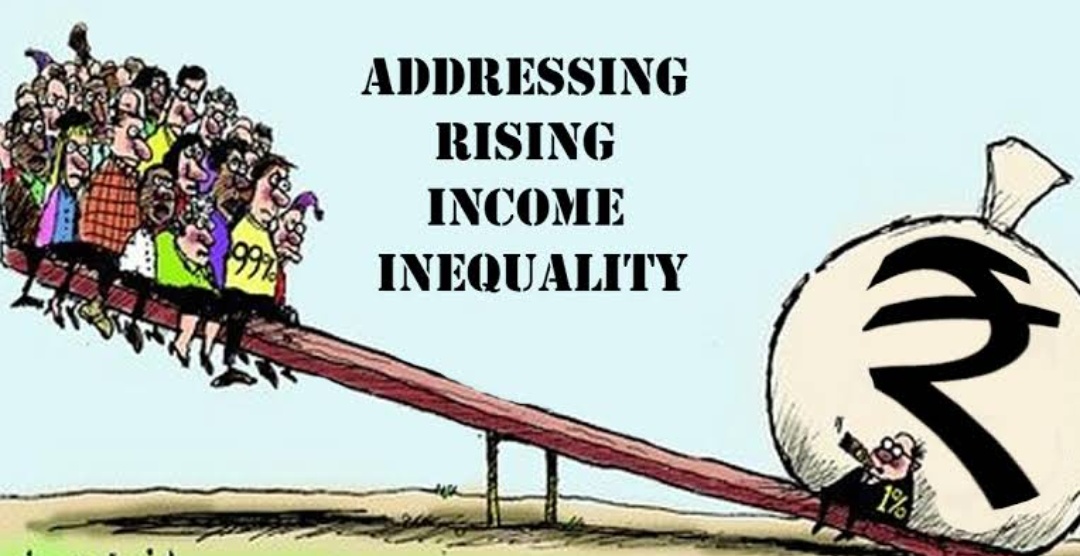
Recently, the World Bank released statistics showing the spending patterns of people in 61 countries, along with income trends in some of them. According to this data, India ranked fourth in 2022 among countries with the least disparity. Using this, the central government began promoting the idea that India is the fourth most equitable country in the world. But making such grand claims is laughable at best and doesn’t need further elaboration many researchers have already exposed the flaws in this interpretation. Delving deeper into it would be like trying to kill a snake that’s already dead. Still, a few points need clarification. Instead of debating these unfounded claims, it’s more important to understand what is actually happening in the country’s economy. First, let’s briefly examine how baseless the government’s claims are. It’s meaningless to generalize about the whole world based on data from just 61 countries. Second, income disparities are usually larger than disparities in spending. As income increases, the proportion spent on consumption generally decreases while the savings rate increases. Hence, expenditure inequality tends to be low in most countries, but income inequality is much more significant. Therefore, using either income or expenditure disparities selectively to assess inequality leads to unreliable conclusions. Another important point people at the lowest income levels typically have no capacity to save. In fact, they often borrow just to meet basic needs, especially when it comes to healthcare. This makes assessing inequality based solely on spending quite misleading. It’s well known that people at the bottom of the economic ladder are burdened with debt.
Some states have introduced laws like the LDF’s Farm Loan Waiver Act, aiming to prevent farmer suicides. Reviews found that a major reason for these suicides was debt incurred for medical needs (Some even argued that the law should be amended to cover only those who borrowed for agricultural purposes). Another issue high-income individuals are often underrepresented in survey samples due to their small numbers. Researchers usually address this with statistical adjustments, but no such corrections were made in the World Bank’s report. Similar gaps exist in data from other countries included in the study. When the World Bank estimates inequality based on spending, it attempts to assess overall wealth distribution. This method can also be misleading. For instance, suppose the income share of the richest 1% increases while the income of the lower-middle classes falls, pushing them down the economic ladder. The inequality index might still show that disparities have decreased, because the middle groups lost income, creating the illusion of narrowing gaps when in fact the rich got richer at everyone else’s expense. If income inequality were truly shrinking in India, why are hunger and malnutrition still so widespread? What’s the government’s answer to that? The government claims that India’s GDP growth rate is among the highest globally. If that’s true, and inequality is also reducing, shouldn’t even the poorest see some increase in income? Then why does India rank 107th out of 125 countries in food grain consumption? Why is anemia rising among Indian women? Why is the percentage of people unable to access basic nutrition increasing? This is happening because the wealth generated from GDP growth is being captured almost entirely by the richest segments of society. The World Bank’s inequality index fails to reflect this reality. As an alternative, Thomas Piketty and his team collected statistics for their World Inequality Index. According to their 2023–24 report, the top 1% in India now hold 23% of the country’s income a record high in the past hundred years. The neoliberal policies being implemented have pushed essential services like healthcare and education increasingly into private hands, contributing heavily to growing income inequality. The rich always opt for expensive private healthcare. The poor rely on public facilities. When public healthcare shrinks, the poor are forced into costly private treatment, raising their expenses. So even as their income falls, their costs rise. Using this increase in spending to argue that inequality is decreasing is utterly illogical.
When healthcare costs rise, the poor are compelled to cut other essential expenses like food. If not, they borrow. So the government’s claim that inequality is decreasing contradicts the actual situation. Every day, newspapers report cases of overcrowded public hospitals, delayed treatment, or people losing their children because they couldn’t afford private care. These aren’t isolated events. Privatizing essential services, making them unaffordable and then claiming that inequality is shrinking showcases the government’s complete irresponsibility.