
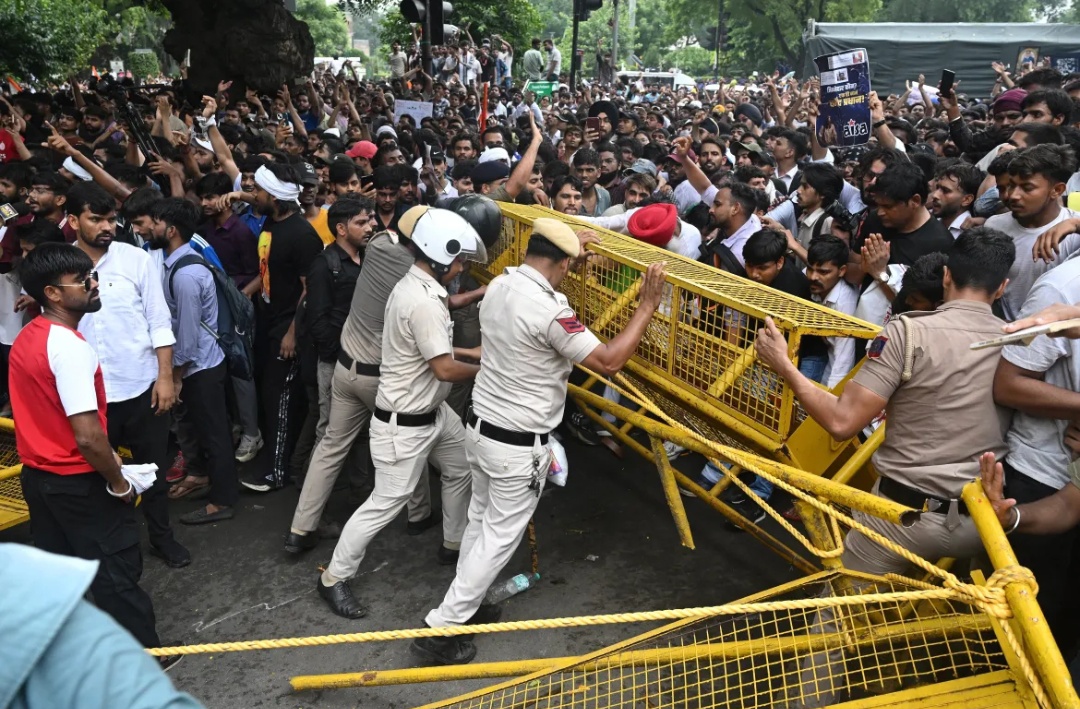
Delhi was shaken. The Central Government, which underestimated the anger, frustration, anguish and determination of India’s youth, was stunned by the scale and resolve of the young protesters. A ‘Parliament March’ organized by the Cockroach Janata Party (CJP) demanding the resignation of Union Education Minister Dharmendra Pradhan over the alleged NEET paper leak and CBSE irregularities, the dissolution of the National Testing Agency (NTA), and the withdrawal of the National Education Policy (NEP) turned highly tense.
Despite heavy rainfall in Delhi, thousands of students and young people voluntarily attempted to march toward the Parliament complex. Security forces and police resorted to lathi charges, fired tear gas and used water cannons to disperse the crowd. Carrying the Indian national flag and portraits of Dr. B.R. Ambedkar, Bhagat Singh, and Mahatma Gandhi, the protesters continued advancing toward Parliament despite being beaten with batons. Many students and youth sustained injuries during the clashes. Hundreds were detained and taken to various police stations across Delhi. Nevertheless, the protesters refused to back down.
Inside Parliament, opposition parties strongly criticized the government, questioning why the demands raised by the CJP were being ignored and demanding accountability for the alleged failures and negligence surrounding the examination system. As tensions escalated both inside and outside Parliament, the government was compelled to respond. Union Minister JP Nadda held talks with CJP leaders, during which they reiterated their three primary demands. Meanwhile, Union Education Minister Dharmendra Pradhan met with Home Minister Amit Shah.
Environmental activist Sonam Wangchuk continued his hunger strike in hospital. CJP founder Abhijeet Deepke, SFI leaders Adarsh M Saji and Aishe Ghosh and AISF leaders Neha, Manish and Ameen ended their hunger strikes after receiving assurances of continued support, while declaring that the broader movement would continue until justice was served.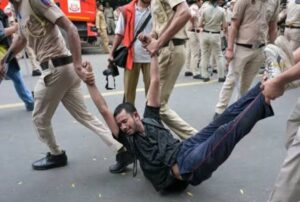
● Jantar Mantar Overflowed with Protesters.
The Parliament March led by the CJP transformed Jantar Mantar into a sea of students and young protesters. Thousands gathered voluntarily, bringing much of the national capital to a standstill. Despite heavy rain and strict police restrictions, participants remained undeterred. From early morning, students and supporters from across the country assembled at Jantar Mantar. Several actors, politicians, democracy activists, and human rights campaigners also joined the protest in solidarity.
● Roadblocks Across Delhi.
Even before Parliament convened, police and central security forces intercepted large groups of students arriving from different parts of the country at metro stations and other locations to prevent them from reaching Jantar Mantar. Police also stopped Members of Parliament, political leaders, and other prominent personalities who had come to express support for CJP chief Abhijeet Deepke, leading to heated arguments before they were eventually allowed to reach the hunger strike venue. Delhi Police, backed by the Rapid Action Force (RAF) and paramilitary personnel, established extensive security measures throughout the city. Water cannons, tear gas, barricades and fencing were used to contain demonstrators.
Hundreds reportedly suffered injuries during police baton charges. Drone footage showed protesters stretching for several kilometers around Jantar Mantar, Parliament Street, Raisina Hill, India Gate, Rajendra Prasad Road and much of Central Delhi.
● March Toward Parliament.
- In the afternoon, thousands marched from Jantar Mantar toward Parliament, carrying the national flag and portraits of Ambedkar, Bhagat Singh, Mahatma Gandhi and other national icons while chanting slogans peacefully. Some attempted to reach Parliament via Sansad Marg but were stopped by security personnel. Police carried out baton charges, injuring several demonstrators, many of whom received first aid on the spot.
Another group advanced from the Jantar Mantar Circle toward Parliament. Despite repeated attempts by police to stop them, the sheer number of protesters made containment difficult. As they moved through Raisina Hill, the Rapid Action Force fired tear gas near Rail Bhavan and the Press Club of India, followed by another baton charge.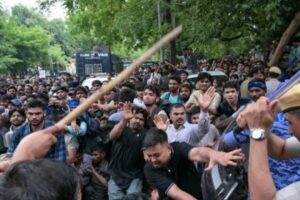
● Parliament’s Main Gate Closed.
As protesters approached the Parliament area, security forces heightened alert levels. The main entrance used by the Vice President, Prime Minister, Home Minister, Cabinet Ministers, and Members of Parliament from Vijay Chowk was locked. Water hoses resembling fire-engine pipelines were positioned to block any advance, while CISF personnel reportedly assumed tactical positions in case the situation deteriorated. Following heightened tensions near the Press Club, nearby central government offices were closed and security tightened.
● Beat Us If You Must.
Although barricades had been erected on roads leading to India Gate and Parliament, protesters crossed them in large numbers, frustrating government efforts to contain the demonstration. The Parliament vicinity became crowded with protesters, described by the article as ‘Cockroaches’ apparently a self-referential or symbolic label used by the movement. Police allegedly targeted individual protesters, surrounding and beating them. One widely circulated video showed a protester, surrounded by five Rapid Action Force personnel, repeatedly shouting, ‘Beat me as much as you want’ while enduring the assault. Another young protester reportedly suffered a severe leg injury during the baton charge but continued shouting slogans.
Earlier, CJP had appealed to supporters to remain peaceful despite police obstruction, stating that the movement would succeed only through peace and nonviolence. According to the article, protesters largely adhered to this call. The report further alleges that police attacked actors Prakash Raj and Shabana Azmi, assaulted activist Geetanjali Angmo and dismantled protest stages at Jantar Mantar.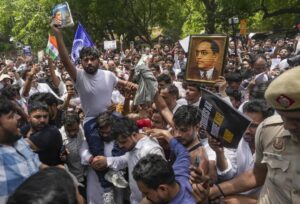
● Metro Stations Closed.
Ahead of the Parliament March, the Delhi Metro Rail Corporation (DMRC) closed several stations connected to Parliament, including Janpath, Rajiv Chowk, Patel Chowk, Central Secretariat, Seva Teerth. Heavy security was also deployed around Lok Kalyan Marg metro station near the Prime Minister’s residence. Multiple barricades were erected, and internet and mobile network services in parts of Central Delhi were reportedly suspended.
● Talks with JP Nadda.
As tensions escalated, Union Minister JP Nadda met CJP representatives Ashutosh Ranga and Sourav Das. The delegation submitted a memorandum demanding the immediate resignation and dismissal of Education Minister Dharmendra Pradhan. Nadda reportedly assured them that their demands would be discussed at the appropriate level. However, Sourav Das later stated that no concrete assurances had been received and that peaceful protests would continue until their demands were accepted. Meanwhile, Dharmendra Pradhan met Home Minister Amit Shah inside Parliament.
● Opposition Condemns Government Response.
The events caused significant disruption during the opening of Parliament. Opposition parties including the Congress, CPI(M), Trinamool Congress (TMC), DMK, AAP, Samajwadi Party, NCP and several others condemned the police action and criticized the government’s handling of the protests. Environmental activist Sonam Wangchuk announced that he would continue his hunger strike. Meanwhile, CJP founder Abhijeet Deepke, SFI leaders Adarsh M Saji and Aishe Ghosh and AISF leaders Neha, Manish and Ameen ended their fasts after receiving lemon juice from supporters, including CPI(M) MP Amra Ram, veteran actress Shabana Azmi, actor Prakash Raj, RJD MP Manoj Kumar Jha, RJD leader Raja Ram Pal, social activist Yogendra Yadav and former soldier Rajesh Thapa, whose daughter Riya Thapa reportedly died by suicide in Uttarakhand following the NEET paper leak controversy.
The ceremony was attended by senior CPI(M) leaders including M.A. Baby, Brinda Karat, R Arun Kumar, Viju Krishnan, Nilotpal Basu, Kanika Ghosh and B Venkat.
Although the hunger strikes concluded, CJP leaders declared that their movement would continue until Dharmendra Pradhan resigned. Later, confusion arose over reports that Abhijeet Deepke had been arrested. CJP spokesperson Sourav Das claimed on X (formerly Twitter) that Deepke had been taken into custody. Delhi Police denied the claim, stating through its official X account that Deepke had not been arrested and remained at the protest venue.