

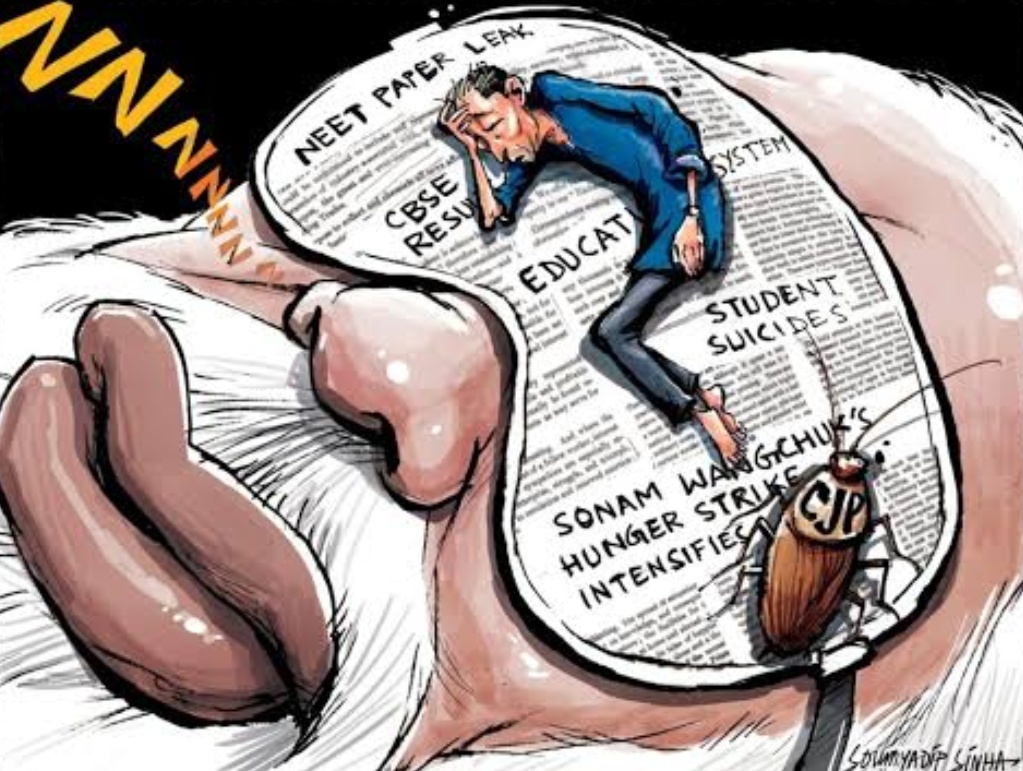
Educationist and education activist Sonam Wangchuk has now been on a hunger strike for more than two weeks. In the absence of any sense of responsibility or response from the government, his life is at risk. He has received widespread solidarity from student organizations as well as broad democratic and secular sections of society. His protest has successfully drawn the nation’s attention to the deteriorating condition of India’s education system. Naturally, the demand for the resignation of the Education Minister has emerged as a central issue. However, the protest has also exposed the many complex crises confronting the education system as a whole. It appears that India has drifted far from the constitutional vision, the goals adopted after Independence, and the educational philosophy and model envisioned for the country. Education was originally conceived as a powerful instrument to dismantle the legacy of colonial rule. Democratic access to education based on equality and inclusiveness was regarded as one of its fundamental pillars.
According to the Directive Principles of State Policy, Article 45 of the Constitution assigned the post-Independence government the responsibility of providing education to all children between the ages of six and fourteen. The emphasis on universal education reflected the commitment to ensure access for everyone, irrespective of caste, religion, tribe, ethnicity or economic status. In 1993, the Supreme Court, while revisiting its earlier judgment in the Mohini Jain case, declared education a fundamental right for children below the age of fourteen. This landmark judgment directly led to the insertion of Article 21A through the 86th Constitutional Amendment in 2002, making free and compulsory education mandatory for all children aged six to fourteen. Active schemes for child nutrition and education were also introduced. Although inadequate funding limited their effectiveness, programs such as Anganwadi centres and the Mid-Day Meal Scheme significantly strengthened the process. The underlying principles of these initiatives were undoubtedly sound.
● NITI Aayog Report.
From the mid-1980s onward, however, the situation gradually began to change. The introduction of neoliberal economic reforms completely altered the landscape. While the principle that government investment is essential for educational development was not formally abandoned, it increasingly came under challenge. From the 1990s onward, education policy steadily moved in three directions commercialization, centralization and to some extent, communalization. These ‘three Cs’ became increasingly dominant. After the Modi government firmly established itself, corporatization and saffronization accelerated even further. The National Education Policy (NEP) 2020, according to critics, was shaped both by the ideological influence of the RSS and by corporate interests seeking greater profit opportunities. Amid the fanfare surrounding the policy, society largely failed to recognize its true implications. Today, however, its impact has become unmistakably visible. According to a NITI Aayog report 94,000 government schools across India have been closed over the past decade. Instead of expanding educational access, student enrollment has fallen by 22.6 million (2.26 crore). On average, 25 schools are shutting down every day.
The report paints an especially grim picture of rural India. A closer examination shows that the worst-affected regions are those predominantly inhabited by Adivasi and Dalit communities. Government schools declined from 1.107 million in 2014-15 to 1.013 million in 2024-25. During the same period, government aided schools also fell from 83,000 to 79,000. In contrast, private schools increased from 288,000 to 339,000 during the same decade. Such rapid growth of private institutions inevitably undermines affordability and accessibility. The report also reveals that student enrollment declined in proportion to school closures. It reluctantly acknowledges that this contraction largely resulted from the mergers and consolidation of schools envisioned under NEP 2020. As a consequence, neighborhood schools have virtually disappeared. When the situation is so alarming at the foundational level, it is unsurprising that dropout rates rise sharply at higher levels of education. Although India’s educational data may not always be comprehensive, the seriousness of the situation is evident. Within just ten years, 550 new universities have been established, the majority under private management. According to the Ministry of Education’s All India Survey on Higher Education (AISHE), the pattern of university establishments has changed dramatically. Between 2013-14 and 2023-24, the number of private universities rose from 219 to 546, an increase of approximately 149 percent. During the same period, government universities increased only from 504 to 733, representing a growth of about 45 percent.
● Commercialization and Centralization.
The sharp decline in funding for higher education and research is a direct consequence of policies encouraging greater corporate participation, primarily to facilitate private profit. Commercialization has expanded beyond educational institutions themselves to include core academic functions. Alongside commercialization, extreme centralization has become another defining feature of the NEP. Since the RSS played a role in shaping the policy, critics argue that this threatens India’s foundational principle of ‘Unity in diversity’. Centralization has become the mechanism through which this ideological framework is implemented. A striking example is the National Testing Agency (NTA). The massive irregularities in the NEET-UG examination exposed the agency’s serious failures. Since 2017, many centrally conducted examinations have been tainted by irregularities ranging from minor malpractice to major scandals. The expansion of centralized entrance examinations, including common admission tests for central universities, has only intensified these concerns. Investigations have also revealed that private educational institutions and the coaching industry have played a significant role in this large-scale corruption. As a result, the possibility of ensuring equitable and genuinely free access to education is being systematically undermined. Growing public frustration has made the demand for the resignation of Education Minister Dharmendra Pradhan a prominent slogan of the opposition.
● Damage to the Curriculum.
Commercialization and centralization have together become the twin pillars of the new educational model. Through centralized institutions and regulatory mechanisms, RSS-affiliated individuals and organizations have, critics argue, gained extensive influence over educational policymaking. Consequently, school curricula and textbooks are increasingly being infused with religious ideology. History, critics contend, is being replaced by mythology, while science is being presented less through empirical inquiry and more through ancient legends. Today, more than ever before, there is an urgent need to defend education as a fundamental right and as a means of ensuring development, equality, and universal access. At the same time, protecting the scientific temper and preserving rational thinking have become immediate necessities. Achieving these goals requires not only building broad educational coalitions but also mobilizing wider sections of society beyond the traditional educational community. Only through such collective efforts, the argument concludes, can these foundational principles be safeguarded.