

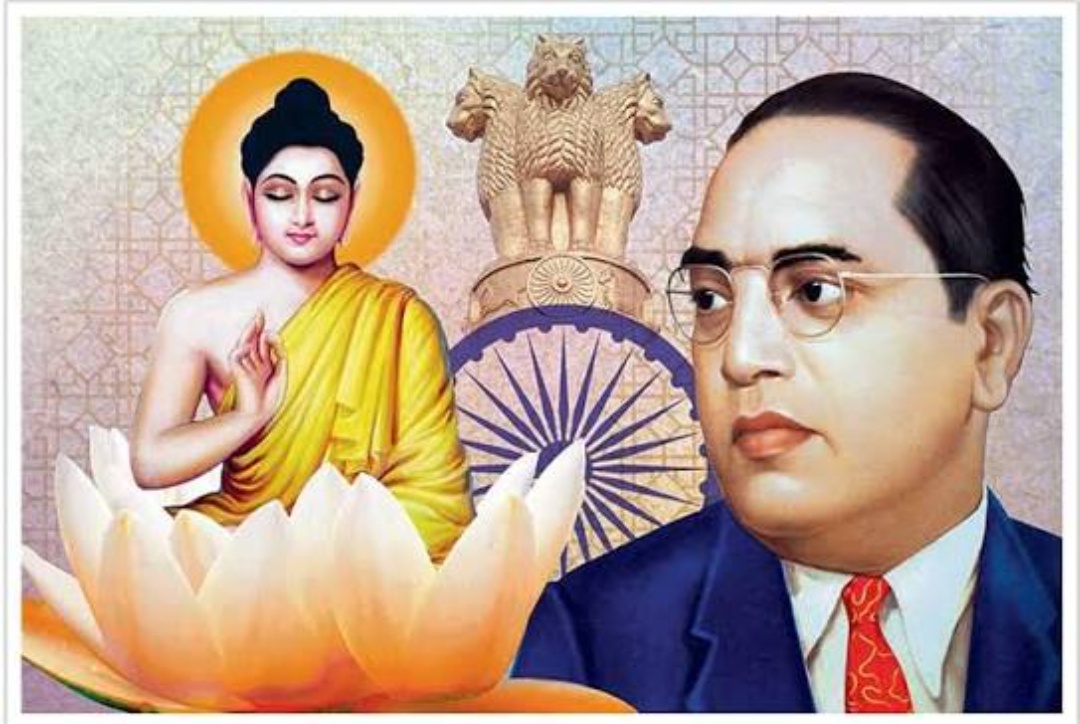
On October 14, 1956, Dr. B. R. Ambedkar, along with five hundred thousand of his followers, embraced Buddhism. The grand event held in Nagpur was not merely a change of religion, it was a historic step symbolizing his resolve to establish morality, equality and social justice in India. It became the largest religious conversion in world history. Let us explore some significant aspects related to this transformation.
● Why Did Ambedkar Leave Hinduism?
The caste system is the foundational social principle of Hinduism. Ambedkar was born a Hindu, but as a member of the Mahar caste, he faced the cruelties of untouchability from childhood. In 1901, when young Ambedkar and his brother set out from Satara to Koregaon to meet their father, no one at the Koregaon railway station would take them to his home simply because they were untouchables. They spent the night without food or water. This incident left a deep scar on the ten-year-old Ambedkar’s mind. Later, while studying abroad, Ambedkar experienced freedom and equality for the first time but that was short-lived. Upon returning to India, the shadow of ‘Manu’ (Manusmriti) haunted him again. When he took a job as the Military Secretary under Baroda’s Maharaja Sayajirao Gaekwad, he faced constant humiliation despite his high position. He couldn’t even find a place to stay in Baroda because of his caste. Once his caste identity was revealed, he was thrown out of a lodging house. Such bitter experiences were countless in his life. The caste oppression within Hinduism sowed the seeds of his determination to seek another faith. His exposure to John Dewey’s Pragmatism during his studies at Columbia University also shaped his thought. Dewey’s ideas on freedom, equality and fraternity influenced him deeply values Ambedkar later saw embodied in Buddhism. Through reading Henry Clarke Warren’s ‘Buddhism in Translation’ and studying the edicts of Ashoka, Ambedkar realized that these humanistic values had originated in Indian Buddhism itself. His personal experiences of humiliation combined with his intellectual understanding of modern democratic ideals convinced him that he must leave Hinduism.
In 1935, at the Yeola Conference, Ambedkar made his historic declaration ‘I was born a Hindu, but I will not die a Hindu’. In 1936, he published Annihilation of Caste, writing ‘You cannot build anything on the foundation of caste. You cannot build a nation, you cannot build morality’.
● Which Religions Invited Him and Why Did He Refuse Them?
After the 1935 Yeola Declaration, Ambedkar began searching for a religion that aligned with his ideals. Leaders from Hindu reform movements, Islam, Christianity and Sikhism invited him to join their faiths. Hindu leaders from the Arya Samaj and Prarthana Samaj urged him to remain within Hinduism and lead a reform movement. Ambedkar rejected this, saying no religion based on caste could uphold equality. Muslim leaders, including Aga Khan, promised dignity and social progress for Dalits if they converted to Islam. Ambedkar declined, seeing Islam as deeply entangled in communal politics in India. Christian missionaries from the Church Mission Society also approached him, but Ambedkar observed that Indian Christianity was not free from caste divisions and that the faith relied on belief over reason. Sikhism appealed to him for a while, but he ultimately felt that its geographical limitations made it less suitable for a nationwide transformation.
● Why Buddhism?
While studying at Columbia University, Ambedkar had read widely on Buddhism, particularly works translated from Pali. He recognized in Buddhism a rational, ethical, and humanistic alternative to the caste-ridden Hindu system. Books such as T. W. Rhys Davids’ ‘Dialogues of the Buddha and ‘Buddhism Its History and Literature’ portrayed the Buddha as a humanitarian and social revolutionary. Further readings of Hermann Oldenberg, I. B. Horner and D. T. Suzuki deepened his conviction that Buddhism represented a moral, democratic and socially conscious religion and one with authentic Indian roots.
Dharmachakra Pravartan (Turning of the Wheel of Dharma). In 1955, Ambedkar founded the Buddhist Society of India and began organizing a mass conversion ceremony. On October 14, 1956, at Deekshabhoomi in Nagpur, Ambedkar and hundreds of thousands of followers were formally initiated into Buddhism by Bhikkhu Chandramani. They recited the Three Refuges (Buddha, Dhamma, Sangha) and the Five Precepts, marking their entry into the Buddhist fold. Ambedkar also administered the ’22 Vows’, in which he and his followers explicitly rejected Hindu deities and customs. In his speech, he declared ‘I have left the religion that represents inequality and entered the religion that preaches freedom, equality and fraternity. My conversion is not for wealth or power it is for the dignity of mankind’. Within a year, over five million people followed Ambedkar into Buddhism.
On December 6, 1956, Dr. Ambedkar passed away but his act had already transformed Indian social history. The Ideological Basis of Ambedkar’s Conversion embraced Buddhism because it centered human beings instead of God and was grounded in reason, morality, and scientific thought, rather than blind faith or ritual. Buddhism rejects the caste system. Kings, merchants, rich and poor alike can be part of the Sangha without discrimination. It preaches equality and fraternity and stands against greed and exploitation. It promotes just economic distribution and righteous livelihood, ensuring economic justice. Its principles of freedom, equality and brotherhood resonated with Ambedkar’s vision of a democratic society. Thus, Ambedkar’s conversion to Buddhism gave millions of Dalits a path to dignity, self-respect and liberation from the oppressive hierarchy of caste.
In essence, Ambedkar’s embrace of Buddhism was not a religious shift but a moral and social revolution a conscious choice to rebuild Indian society on the foundations of reason, equality and human dignity.