
Attorney General for India Calls for a New Framework for Plea Bargaining at Seminar on Delivering Justice In Time

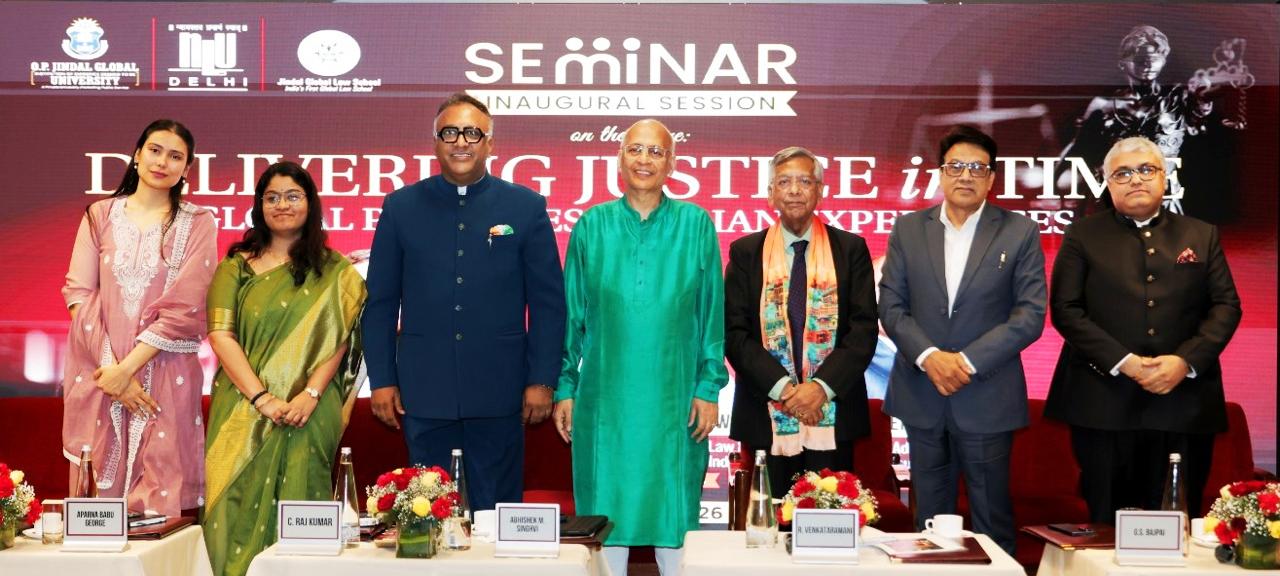
Mr. R. Venkataramani, Attorney General for India, called for a new framework for plea bargaining based on social, cultural, economic theories and practices at the inaugural session of the seminar on “Delivering Justice in Time: Global Practices and Indian Experiences”, jointly organised by O.P. Jindal Global University and the National Law University Delhi.
“Plea bargaining is becoming universal. There’s a new need for a national protocol for plea bargaining, a national protocol which can be evolved and which can, in a very healthy way, advise, guide and counsel practitioners as well as victims of justice, so that the protocol can work in a more transparent and objective way. The legal and civil authority should be prepared to play important roles. The Chief Justice of India has consented to have a strong internal discussion on it. Existing legal mechanisms will also be made ready to look with a new lens and that there is concession for the defense and the resource management for the state. The resource management for the state is not only relevant for the plea bargaining aspect. It is resource value for the state, essentially, like an economic principle which should run through the entire administration of justice. This is why I have been thinking about a National Institute for Criminal Justice Administration which will also have an everyday index where we watch the measurement and performance. Those who practice in the trial court will find out how painful it is for people to simply waste their resources for governments, institutions, people, lawyers and judges as well as time!” he said.
In his Keynote Address, Dr. Abhishek M. Singhvi, Senior Advocate, Supreme Court of India & Member of Parliament, spoke about the large pendency of cases in India. “It is the paradox of India’s legal system, capable of producing some of the world’s most sophisticated jurisprudence, while simultaneously struggling with a massive backlog of cases. We need to deal with the ‘ABCD’—the access, backlog, cost and delay issues, and the obvious step is to appoint court judges. We need to fill judicial vacancies, adopt multi-track case management systems, resolve very old cases through dedicated mechanisms, strengthen mediation and revive Gram Nyayalayas, and improve coordination across courts, police and prisons. We need a synergy and focus to deal with the high number of pending cases which is also holistic. We need a curative and preventive approach and unconventional in a bold, new methodology to address the issue. The other extreme, which is a big failure, is arbitration. Arbitration has become pre-litigation litigation which is just adding one more separate limb to the process but the reality is that there are not enough trained mediators and this needs to be addressed on a war footing. There is also the issue of human infrastructure. The criminal law justice system includes the criminal hearing judge, the police and the prison staff and all these have to be synergically coordinated.” He also called for reconsidering the retirement age disparity between High Courts and the Supreme Court and emphasized long-term consistency in reform implementation.
