

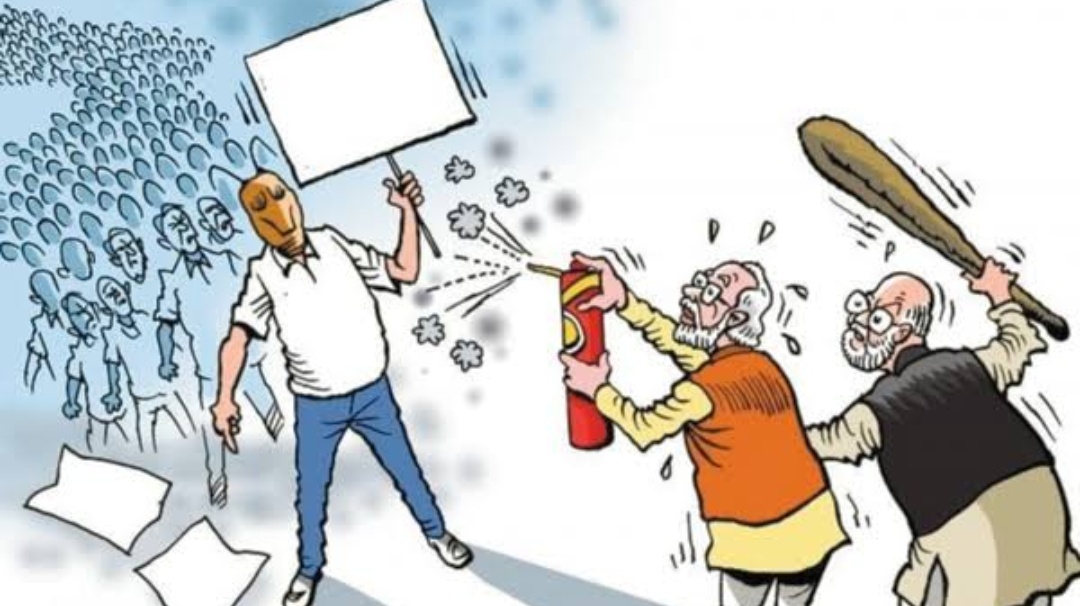
There was unrest, There was hope And above all, there was a determination to move forward somehow. The current transitional phase following the legislative election results appears somewhat unreal. The BJP and the RSS are actively promoting a narrative that the BJP has become invincible as a political force and, more importantly, that no alternative can replace it. Where is this leading Indian democracy..??
A famous observation made by Karl Marx in his 1852 essay The Eighteenth Brumaire of Louis Bonaparte comes to mind. According to Marx, history is shaped by real-world conditions rather than by human imagination. ‘Men make their own history, but they do not make it as they please; they do not make it under circumstances chosen by themselves, but under circumstances directly encountered, given and transmitted from the past’.
● Examination Fraud and the Emergence of the Cockroaches.
Although Marx was speaking in a different context, his observation aptly describes the current transitional phase. In an atmosphere where even asking a simple question is often branded anti-national, the developments that have unfolded online over the past fifteen days were hardly foreseeable. An attempt to hold the government accountable was met with scattered dismissal. Those involved were described as ‘cockroaches’ and ‘parasites’. At first glance, it seems strange that living, breathing young people would willingly identify themselves as cockroaches, just as strange as the irresponsible remark that prompted it. Yet, upon closer examination, the symbolism becomes meaningful. Cockroaches are known for their extraordinary ability to survive even under the harshest conditions. They endure where others perish. In this sense, they symbolize an effort to break through dangerous silence and indifference. It does not take a rocket scientist to understand why young people have responded so intensely. Their reaction stems directly from the circumstances they face. The examinations conducted by the National Testing Agency (NTA) have increasingly come under scrutiny. Allegations of irregularities, fraud, cancellations, invalidations, and uncertainty have surrounded major examinations, including NEET-UG and assessments conducted through the CBSE on-screen marking system. Now even the IIT entrance examination, JEE, has become part of the controversy, with the situation reaching a peak in 2026.
Perhaps the most troubling aspect of this entire episode is the near-total absence of accountability from the Ministry of Human Resource Development and, more broadly, from the government itself. Any government claiming democratic legitimacy would at least respond responsibly. Yet, in the present environment where criticism is discouraged and independent thought often finds little room, we are left with ostriches burying their heads in the sand. Such conditions provide fertile ground for authoritarian tendencies.
● Why Is This Happening on the Digital Stage..??
At the very least, HRD Minister Dharmendra Pradhan should resign. If young people are to regain trust in an elected government, such a step would be essential. However, this issue extends beyond the examinations of 2026. The credibility of more than seventy examinations conducted by the NTA over several years has become questionable. Serious corrective measures are therefore unavoidable. The ‘cockroaches’, who have become a symbol of collective youth resistance, have now entered the arena. Looking back, this was bound to happen. It was only a matter of time. Failures of this magnitude especially when accountability itself becomes a subject of ridicule inevitably generates some form of rebellion. Today’s youth are far from naïve. They are digitally connected, informed, and capable of mobilizing online. It is therefore natural that the internet has become the stage for their protest. The so-called Cockroach Janata Party (CJP) has thus far limited itself to demanding Dharmendra Pradhan’s resignation. It has not yet expanded its critique to broader structural and institutional issues.
In a country as vast and diverse as India, attempting to centralize all entrance examinations and determine their outcomes through a single administrative framework was always likely to encounter serious difficulties. Furthermore, the BJP’s tendency to appoint individuals aligned with RSS interests to key positions often complicates matters. If merit is sacrificed in the process, the consequences become even more severe. Otherwise, who would seriously imagine that transporting examination papers in Indian Air Force aircraft or having the Prime Minister personally supervise the process could solve such systemic issues? Even if one assumes that extraordinary leaders possess extraordinary abilities, expecting such interventions borders on absurdity. Likewise, the belief that private educational corporations can reliably conduct highly complex national examinations on behalf of the government is itself questionable. Even setting aside concerns that profit motives may overshadow students’ interests, the process was flawed from the outset.
● Everyone Is Walking the Same Path.
Another significant point is that the increasing commercialization of public institutions and education runs contrary to the foundational principles that national policies claim to uphold. Whether they are white-collar professionals, low-paid gig workers, or members of the vast informal labor force struggling to survive, people are increasingly being pushed toward public protest. What is happening to the ‘cockroaches’ today mirrors what previously occurred among workers in Noida, Manesar and Uttarakhand. These locations were not traditionally centers of labor activism, yet the connection is unmistakable. An entire generation of young people is simmering with frustration and anger. The CJP has also raised concerns about middlemen within sections of the judicial system and about the functioning of election commissions. When accumulated disappointment and despair find no credible or dignified channel for expression or reform, such reactions become inevitable. Viewed from this perspective, a remark made by Chief Justice Surya Kant appears less like an accident and more like a trigger. The Supreme Court, critics argue, seems more concerned with protecting the authority of the Election Commission than with safeguarding the constitutional rights of voters. Such developments present a deeply discouraging picture of the current transitional period.
As a result, both the ‘cockroaches’ and the ‘ostriches’ are likely to continue appearing throughout India’s contemporary political landscape. It is within this context that political forces committed to democratic progress must determine their role and position. Only then can they become meaningful participants in shaping the history of their time.