

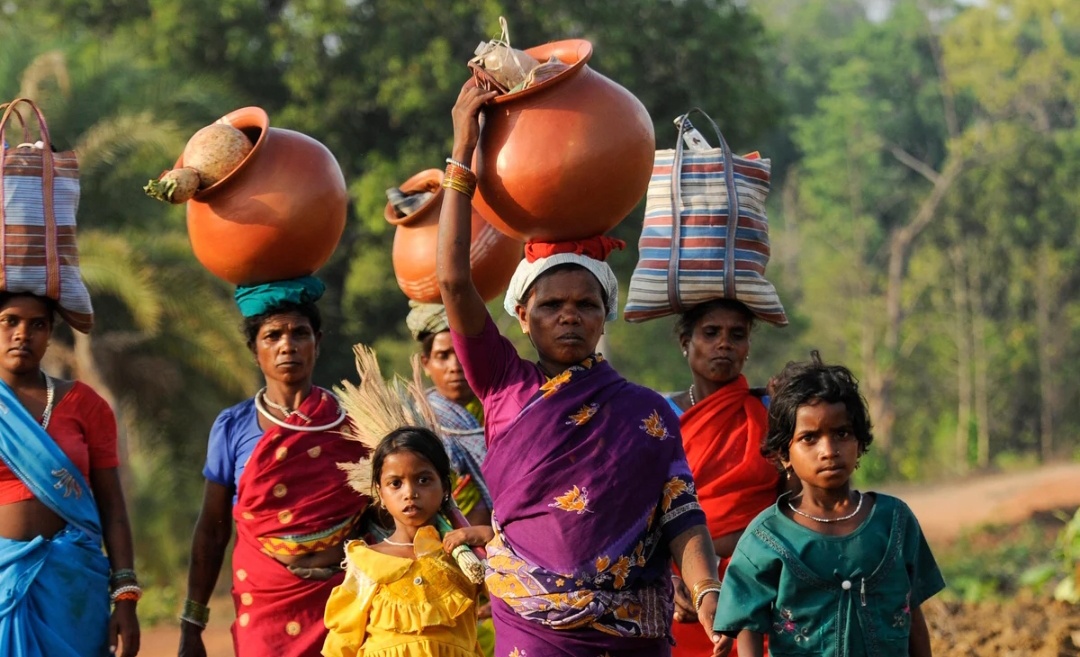
India’s tribal communities have had an inseparable relationship with ‘Jal, Jungle, Zameen’ (water, forests and land) for thousands of years. They have preserved their distinct cultures, customs, and traditions while protecting forests and living in harmony with nature. The Indian Constitution has also recognized the unique identity of tribal communities and granted them political, social and economic rights. Around 750 tribal communities are uniting while preserving their respective customs, traditions, and identities, and are increasingly asserting their rights. However, on May 24, 2026, in Delhi, the Union Home Minister repeatedly referred to tribal people as ‘Vanavasis’ (forest dwellers), which critics argue is an attempt to weaken their original historical and constitutional identity. It is alleged that efforts are being made to create divisions among tribal communities under the banner of Hindu identity. Critics view this as contrary to the spirit of the Constitution.
The terms ‘Adivasi’ (indigenous people) and ‘Girijan’ (tribal people) remind the nation of the history and rights of the original inhabitants of this land. In contrast, critics argue that the term ‘Vanavasi’ reduces them merely to people living in forests, obscuring the historical context of their autonomy, land rights and traditional rights.
According to the author, the repeated use of the term ‘Vanavasi’ is linked to the RSS ideology, drawing from the notion that Lord Rama underwent a period of exile in the forest (Vanavasam), and is seen as an attempt to impose that ideological framework upon tribal communities. The central government, while claiming to be protecting democracy, is accused of simultaneously undermining tribal existence despite highlighting the appointment of a tribal woman as President of India. The article further argues that although the government claims that the proposed Uniform Civil Code (UCC) will not apply to tribal communities, innocent tribal people have been victimized in several states in the name of anti-Naxalite operations. It accuses BJP-led governments of destroying forests across ten states and handing them over to corporate groups such as Adani and Ambani through various agreements. Tribal communities have reportedly been protesting in several states, while police and forest officials are alleged to have attacked protesters and imprisoned them.
The article claims that forests are being exploited for resources such as coal, iron ore, bauxite, manganese, limestone, copper, gold, uranium, sand and other mineral, energy, and nuclear raw materials, with tribal communities bearing the greatest burden of these activities. It states that there are 3,007 active mining leases in the country and that 282,356 square kilometers of forest area are being destroyed. It further claims that 0.09% of the country’s land area is being transferred to large investors and that 312,000 hectares of forest land have been allocated for mining. More than 95 different minerals are reportedly being extracted nationwide.
The article highlights India’s rich biodiversity, including over 47,000 plant species, more than 20,000 flowering plants, around 8,000 tree species, numerous mammals, reptiles, amphibians, fish, insects, birds and other wildlife. It argues that, alongside environmental destruction, the very survival of tribal communities is increasingly under threat. Under Article 342 of the Constitution, tribal communities are entitled to protection, constitutional safeguards, reservations and special welfare benefits. However, the article alleges that government budget allocations for tribal welfare are inadequate and that even the allocated funds are not fully utilized, making tribal livelihoods increasingly difficult. The Fifth Schedule, Sixth Schedule, the Forest Rights Act, 2006, and the PESA Act, 1996 were enacted to protect tribal rights. These laws aim to empower Gram Sabhas (village assemblies), recognize traditional rights over forest resources and provide opportunities for self-governance. According to the article, any action that weakens these rights is contrary to the spirit of the Constitution.
Democracy, it argues, means respecting people’s voices, participation, and rights. Making decisions regarding tribal lands, forests and resources without considering the opinions of tribal communities undermines democratic values. Likewise, failing to implement constitutionally guaranteed rights amounts to weakening democracy itself.
Therefore, the article concludes that governments have a responsibility to protect the constitutional rights of tribal communities, fully implement the PESA Act and the Forest Rights Act, respect the decisions of Gram Sabhas, and preserve the distinct identity of tribal peoples. It ends by suggesting that tribal society may need to prepare for another struggle in pursuit of social justice.