

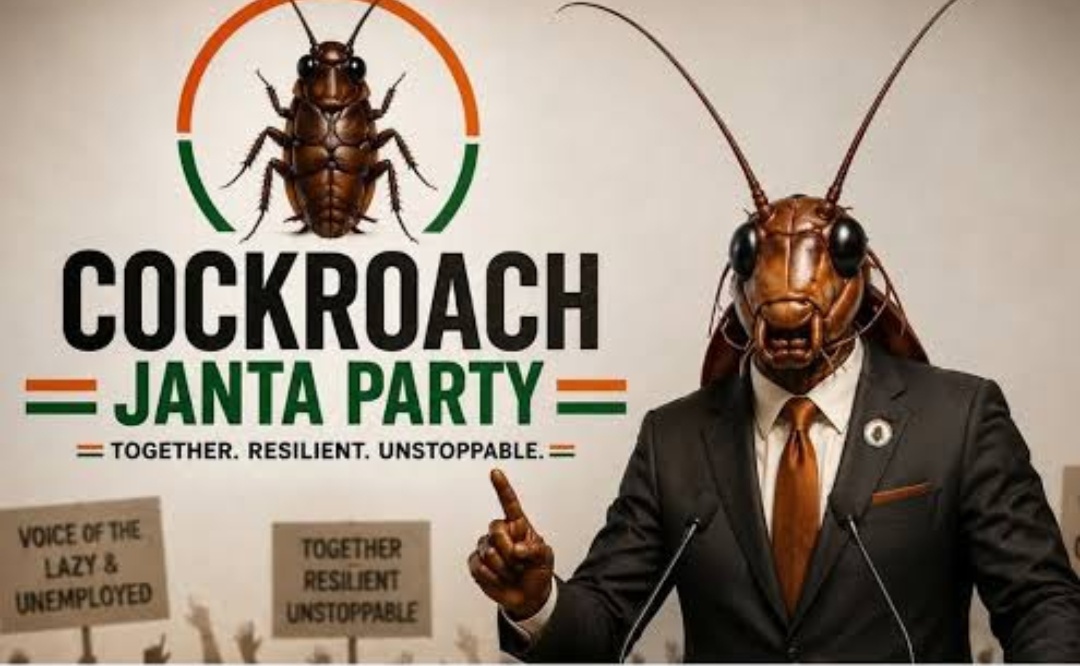
A new chapter has begun in Indian politics. Its name is the ‘Cockroach Janta Party (CJP)’. This is not an ordinary political party, it is a satirical political movement and an online phenomenon that reflects the frustration, anger, disappointment and social media power of India’s youth. Launched on May 16, 2026, the movement surpassed the Instagram followers of the BJP within just a few days. Millions of people reportedly registered as members.
● What exactly happened?
The movement was triggered by remarks made on May 15, 2026, by Supreme Court Chief Justice ‘Justice Surya Kant” during a hearing. He allegedly compared unemployed youth, social media activists, and RTI activists to cockroaches and referred to them as ‘parasites’. Even though he later tried to clarify his comments, the controversy spread like wildfire. Former AAP social media strategist ‘Abhijeet Dipke’ reacted by posting ‘What happens when all the cockroaches unite?’ Soon after, a website, Instagram account and X account were launched under the name ‘Cockroach Janta Party’. The use of the word ‘Janta’ was also seen as a satirical play on the BJP’s branding.
● Why did it gain such huge support?
India’s graduate unemployment rate is estimated to be around 29%, nearly nine times higher than that of people with only school-level education. More than 8 million graduates enter the job market every year, but employment opportunities remain limited. Scandals involving leaks and irregularities in exams such as NEET, CBSE, UPSC and JEE further intensified the anger among young people. That frustration transformed into social media energy.
The movement reportedly gained over 16 million Instagram followers, surpassing the BJP’s online following. Even after its X account was suspended, new accounts emerged and grew rapidly. Memes, reels, and songs like ‘Haan Main Hoon Cockroach’ went viral.
● Why does the ‘cockroach’ symbol matter?
Public frustration and political satire directed at the BJP-led government have been increasing. Many young people have lost faith in traditional politics. Instead of rejecting labels like ‘lazy’ or ‘unemployed’, supporters embraced them and turned them into a symbol of resilience. The cockroach became a metaphor, something impossible to completely destroy, something that survives no matter how many times it is crushed.
● More than meme politics.
This is not just meme politics. It reflects deeper structural issues unemployment, exam corruption, crony capitalism, tensions between the judiciary and executive, And widespread youth dissatisfaction. Gen Z is highly active online, although offline protests remain limited. In an atmosphere where fear and restrictions on free expression are perceived to exist, satire has become a safer and more effective way to speak out.
● What happens next?
Will this movement survive in the long term? Will it evolve into a conventional political force? Or will it fade away as another viral internet trend? If young people can convert this online momentum into real political and social change, it could become a game changer in Indian politics. Otherwise, it may remain just another moment in meme culture.
One message, however, is already clear
Cockroaches reappear even after being crushed. The youth are using that resilience as their symbol. Political leaders and institutions may underestimate it at their own risk. If youth issues remain unresolved, this ‘cockroach swarm’ could grow even stronger.